
Counseling Theories and Techniques
This core course provides a comprehensive overview of the major theoretical frameworks and evidence-based interventions in contemporary counseling practice. Students will explore classical, experiential, cognitive-behavioral, and post-modern theories, moving beyond intellectual understanding to active, real-time application. Through intensive clinical simulations, students will practice case conceptualization and master theory-specific micro-skills to construct a unified, personally integrated approach to client care.
Module 1: Psychodynamic Theory - Exploring Defense Mechanisms
Client Profile

Assignment Description
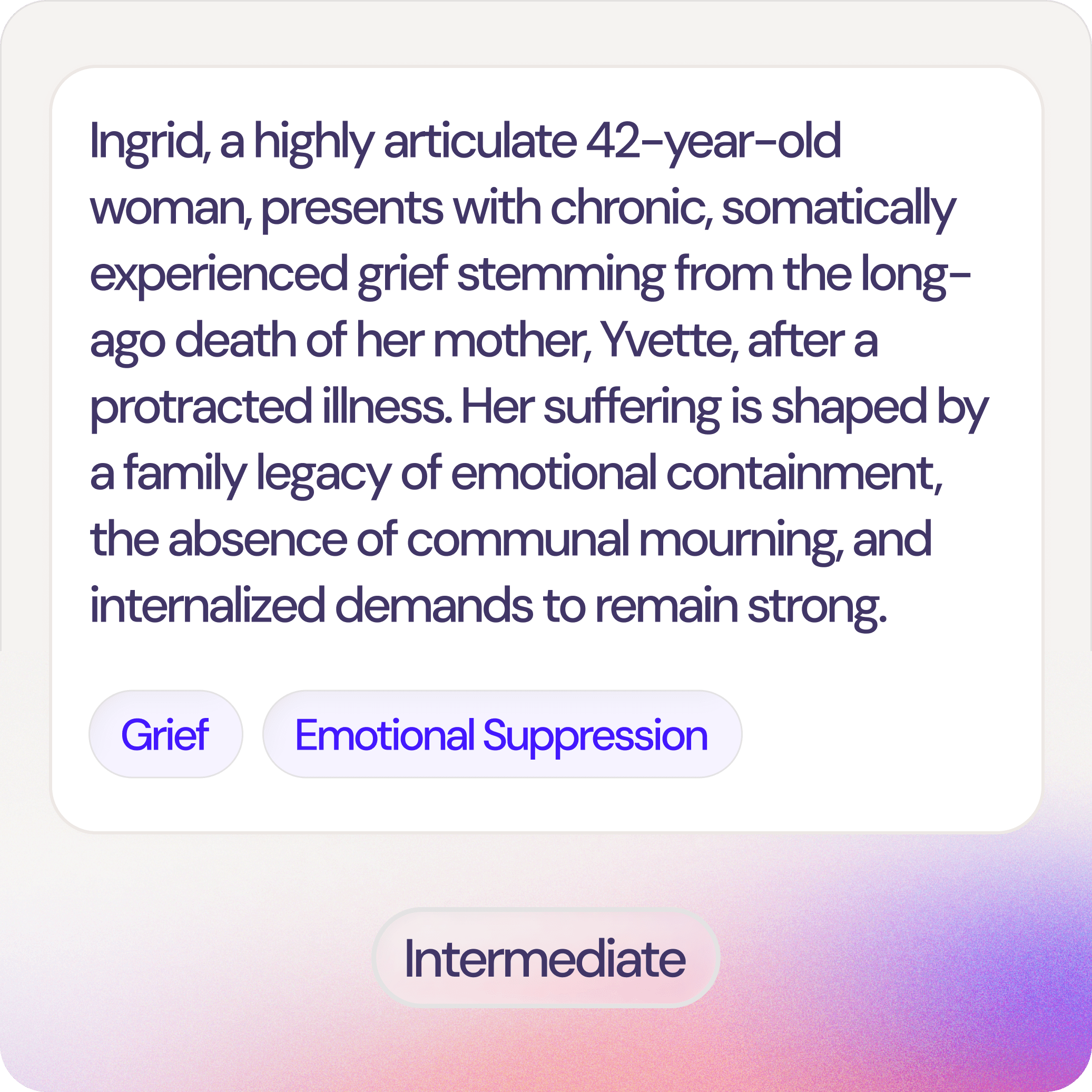
Ingrid relies heavily on the defense mechanisms of intellectualization and compartmentalization to avoid the raw affect of her mother's death. The student's goal is to use psychodynamic principles to gently bypass these cognitive defenses and bring clinical awareness to the underlying, unprocessed grief she is suppressing.
Opening Message
I suppose, um... my file says I’m here for grief counseling. Which is... well, it's accurate, I guess. My mother passed away twenty-five years ago. It’s a long time, obviously... but the memory of it hasn't really faded. Not the way you'd expect it to, anyway. Like, I can still map out those last few weeks... just perfectly in my head. My husband thinks I'm... he thinks I'm too rigid about the whole thing. But... well, when you grow up with a woman like my mother, you just... you learn to handle things. You put the feelings in a box so you can keep functioning. It's just... lately, keeping that box closed... it's taking up way too much energy. And, um... I don't really know why.
Module 2: Gestalt Therapy - Facilitating the Empty Chair Technique
Client Profile

Assignment Description
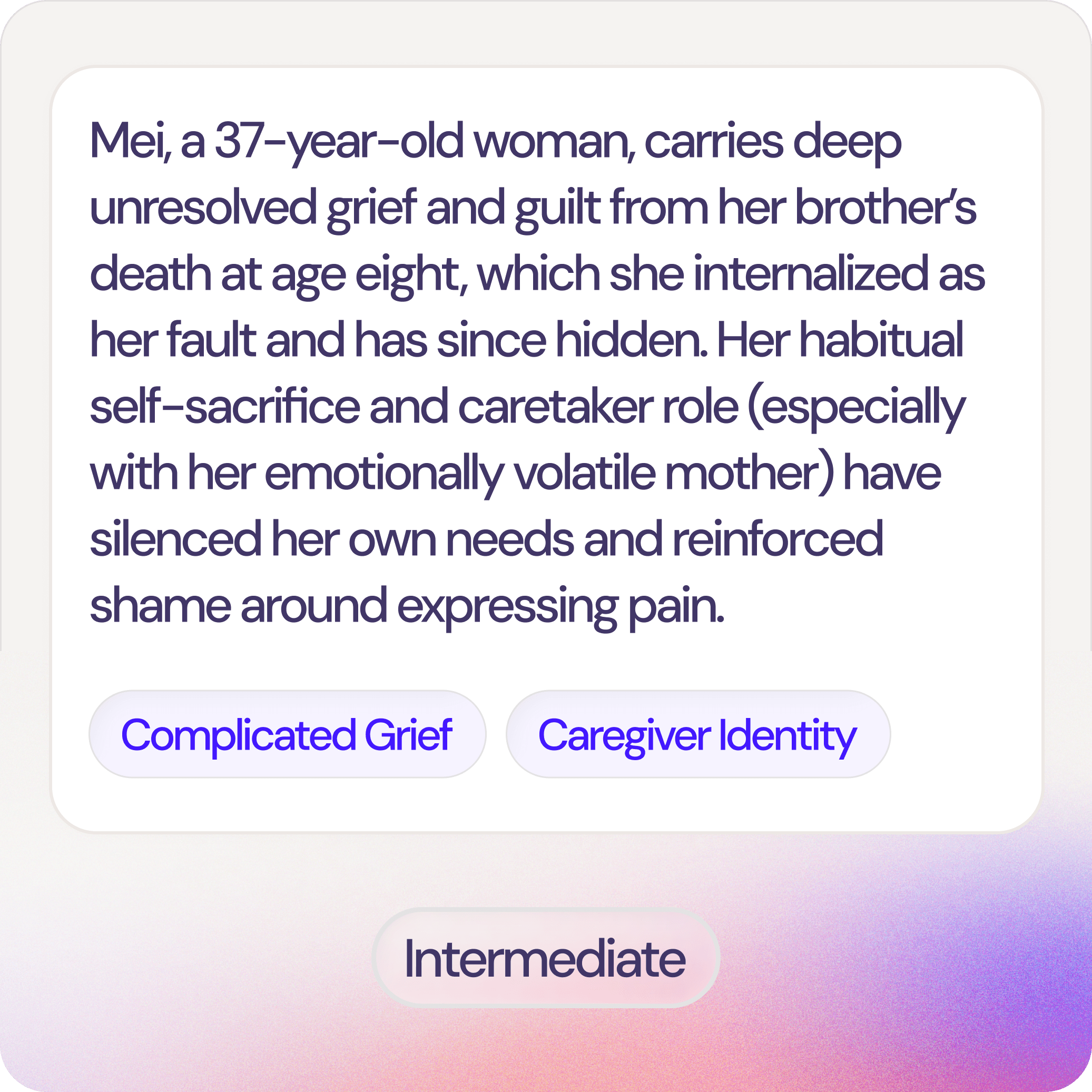
Mei carries intense "unfinished business" and childhood guilt regarding her brother's death. The student will introduce the Gestalt Empty Chair technique to help Mei externalize her suppressed emotions and speak directly to the internalized memory of her brother, allowing her to process her secret shame in the "here and now."
Opening Message
I'm... I'm sorry. I really should have, like... organized my thoughts better before I came in. It's just... Yesterday was my brother's birthday. Or... I mean, it would have been. My sister posted this... this huge tribute online, and then my mom called me, just... completely in tears. So I ended up spending three hours at her house, just... cleaning her kitchen, just to calm her down. And I always do that. I just... I clean, and I fix things for everyone else. I haven't... I haven't actually said his name out loud in... God, in years. It... it physically hurts my throat to even just sit here right now.
Module 3: Cognitive Behavioral Therapy (CBT) - Socratic Questioning
Client Profile


Assignment Description
Caroline harbors severe cognitive distortions related to her husband's suicide, specifically personalizing the blame. The student will use CBT principles, specifically Socratic questioning, to gently challenge and restructure the core belief that her final frustrated sentence ("go right ahead") was the singular cause of his death.
Opening Message
'If you’re going to kill yourself... just... just go right ahead.' That’s what I said. He was... he was standing right there with the rope, and we had been arguing for hours, and my brain was just... it was completely fried. So... I said it. And then he did it. People keep trying to tell me that... that he was sick. Or that it was his choice. Like... like that’s somehow supposed to make me feel better? But it doesn't change anything. I had... I had one chance. One chance to save my husband, and I... I literally handed him the permission to leave.
Module 4: Existential Therapy - Exploring Meaning and Isolation
Client Profile


Assignment Description
Tamera is drowning in caregiver burnout and feels she has lost her identity. The student will apply Existential Therapy principles, focusing on her search for personal meaning, the "given" of isolation, and helping her reclaim her agency and authentic self within a life she feels she didn't choose.
Opening Message
So, my sister was... she was supposed to take the afternoon shift today so I could actually make it here. But, uh... she canceled. Again. I mean, 'the strong one' handles it, right? That’s what they always call me. I moved back in with my mom two years ago... just to help out temporarily. And now... well, my marriage fell apart, my friends stopped calling... and it's like my entire universe is just... managing her dementia medication and... and adult diapers. I feel terrible even saying this out loud, 'cause... I mean, she's my mother. But... I am just so incredibly angry all the time. And then... then I just hate myself for being angry.
Module 5: Rational Emotive Behavior Therapy (REBT) - Disputing Irrational Beliefs
Client Profile


Assignment Description
Joe's self-worth is entirely tied to being the breadwinner, leading to intense anger and depression after losing his mining job. The student will utilize REBT's ABC model to identify and dispute Joe's irrational belief ("I must be the sole financial provider, or else I am a worthless failure to my family").
Opening Message
Marsha's... well, she's the one who wanted me to come talk to somebody. She thinks I’m gonna, like... go back to school to be a mechanic or something. I'm forty years old. I ran a continuous miner for fifteen years, man. I pulled twenty-eight an hour with overtime. That's... that's who I am. We were supposed to close on a house. Like, a real house... with a yard. And now? Now I'm just sitting on the couch at noon while she handles the kids, 'cause... 'cause I can't even look at them. Every time they look at me... all I see is that I can't... I can't provide for 'em anymore.
Module 6: Narrative Therapy - Externalizing the Problem
Client Profile


Assignment Description
Helen is experiencing a profound crisis of purpose after retiring and relocating. The student will use Narrative Therapy techniques to help Helen externalize her feeling of "irrelevance" as a separate entity from herself, allowing her to begin re-authoring her life story beyond the rigid role of Mrs. Jones, the educator.
Opening Message
I... well, I actually bought a new calendar for the apartment yesterday. It’s a habit, I guess... from teaching. For forty years, my whole life was... it was measured by the school bells back in Atlanta. August to June. You always knew exactly where you were supposed to be. I moved out here to be closer to my daughter, which is... it’s lovely, it really is. But... I still haven't unpacked most of my boxes. I wake up at 6:30 every morning... I wipe down a kitchen counter that is already... perfectly clean... and then I just... sit there. I won't call Maya. Because I... I just refuse to be that needy, burden of a mother. So... I just stay quiet."
Module 7: Dialectical Behavior Therapy (DBT) - Distress Tolerance Skills
Client Profile


Assignment Description
Serena is suffering from severe PTSD and uses binge drinking and anger outbursts to cope with hypervigilance. Before trauma processing can occur safely, the student must use DBT distress tolerance skills to help Serena safely manage her physiological arousal and replace her maladaptive, self-medicating behaviors.
Opening Message
My head is... man, my head is killing me. Look, I don’t... I don’t really do the whole 'talking about my feelings' thing. The VA, um, they sent me here 'cause of the... the incident with Leo. He... he just dropped a glass of water. That’s it. And I... I screamed at him so loud he started crying. My own kid. Because my brain... my brain thought the sound was a mortar hitting the pavement. And it happens at work, it happens on the street... I'm just constantly waiting to get hit. The only time my chest isn't tight is after about... I don't know, four glasses of vodka? Which is... yeah. That’s pretty much every night now.
Module 8: Person-Centered Therapy - Establishing Core Conditions
Client Profile


Assignment Description
Tyler is a deeply ashamed and isolated teenager experiencing severe bullying and crushing familial pressure. He expects you to lecture him about his failing grades. The student will practice Person-Centered Therapy, focusing solely on Unconditional Positive Regard, Empathy, and Congruence to create a psychologically safe space, allowing Tyler to drop his defensive silence without feeling interrogated.
Opening Message
The vice principal is, um... he's the one who told my parents I had to come here. So... yeah. I already know what you're gonna say. Like... my dad already gave me the whole lecture about the refugee camp, and how... you know, how I'm just wasting their sacrifices. I know I have a 41 in Algebra, okay? I... I get it. My sister is the pre-med genius, and I'm... I'm just the broken one who hides in the library during third period. So... um... you can just, like... give me the attendance slip for coming? Or... whatever it is I'm supposed to do to prove I was actually here."
Student Learning Outcomes (SLOs)
By the end of this course and its accompanying simulations, students will be able to:
Differentiate between major counseling theories and accurately apply their foundational techniques to simulated clients.
Demonstrate the use of Socratic questioning to identify and restructure harmful cognitive distortions.
Deploy immediate distress tolerance and grounding techniques for clients experiencing acute trauma responses.
Utilize externalizing dialogue to separate a client's core identity from their presenting mental health symptoms.