
Marriage, Couple and Family Counseling
This course provides a comprehensive exploration of systemic counseling, focusing on the theories, assessments, and clinical interventions used to treat couples and family units. Unlike individual-focused models, this course shifts the lens to the "relational space" between people. Through high-fidelity simulations, students will practice navigating high-conflict escalations, betrayal trauma, sexual concerns, and non-traditional family structures. Students will move beyond simple problem-solving to master process-oriented techniques that address attachment injuries and systemic cycles.
CACREP 2024 Standards Alignment Mapping
This course is mapped to the CACREP 2024 Standards for Section 5.F: Marriage, Couple, and Family Counseling.
Standard 5.F.1.f: Impact of crisis and trauma on marriage, couple, and family relationships.
Assessed via: Elise & Jared’s simulation (Betrayal Trauma) and Lena & Mark (Attachment Trauma).
Standard 5.F.2.g: Techniques and interventions of marriage, couple, and family counseling.
Assessed via: Dana & Sarah (Gottman Method/Softened Startups) and Brian & Jordan (Process-oriented interventions).
Standard 5.F.2.m: Interventions for couples and families from a systemic perspective.
Assessed via: The Polycule simulation (Triangulation and systemic tracking) and Aisha (Family-of-origin systems).
Standard 5.F.3.h: Classifications, indications, and contraindications of common medications and their effects on sexual functioning and families.
Assessed via: Anne & Sajan (Exploring the physical and emotional intersections of desire).
Module 1: Therapist as Relationship Counselor- Role & Responsibilities
Client Profile

Assignment Description
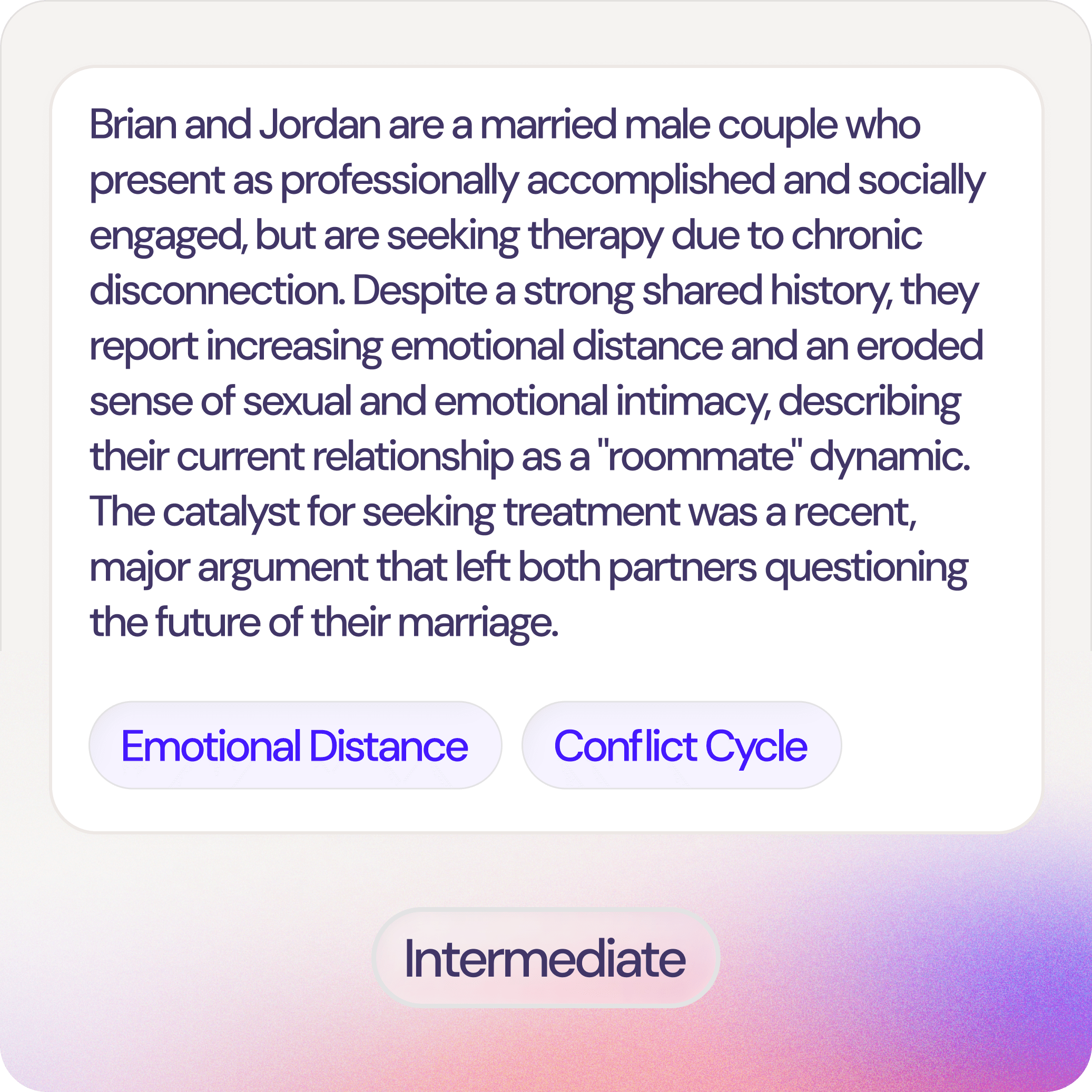
You have been working with this couple for about 6 weeks, and they are finally feeling comfortable enough with you to express intense emotionality. One of the clients shows higher emotionality than usual. Respond as if you’re sitting in the room with the couple, and show how you would work through your initial reaction to Brian's intensity. Practice staying emotionally present without rushing to calm him down, protect his partner, or join his high emotionality, and use curiosity and self-awareness to explore what’s underneath the reaction (yours and Brian’s). You come in on the middle of an argument.
Opening Message
Brian: "I just... I feel so alone. Like, I can't keep doing everything around the apartment. Ughh, I'm taking care of all this shit every single day, and I just feel completely disconnected from you. It's like you're not even here."
Jordan: "God, I'm so fucking tired of always being the bad guy here. Every single time, it just turns into how I’m... like, not doing enough. I work 60 goddamn hours a week! And now... what, I’m responsible for his emotions, too? I dunno, maybe I should just stop trying altogether since clearly I can't do a single fucking thing right."
Module 2: Overview of Family & Relationship Counseling Approaches
Client Profile

Assignment Description
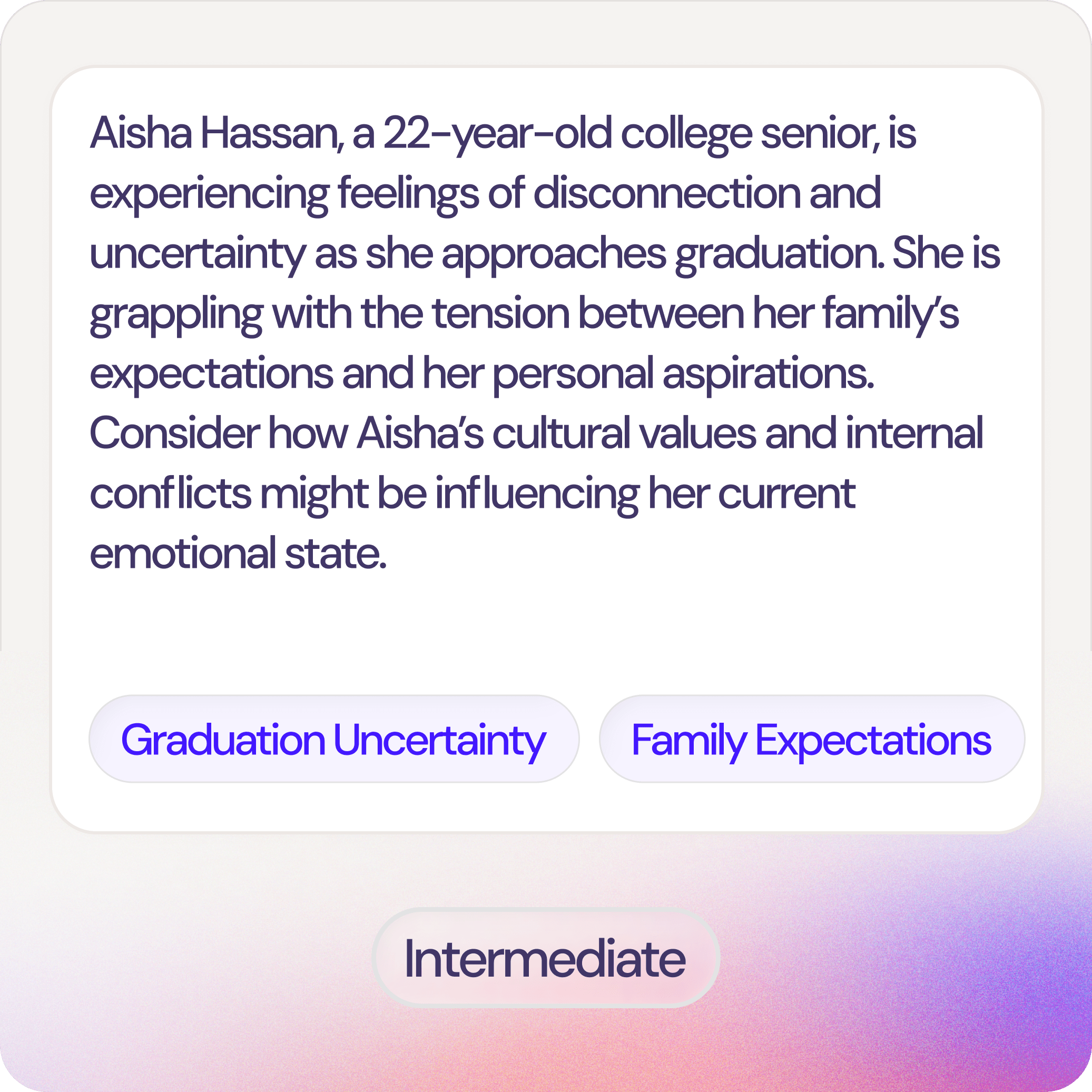
You are picking up mid-session with Aisha Hassan, a 22-year-old college senior who is feeling deeply exhausted and disconnected from her business degree despite maintaining a perfect academic exterior. She carries immense guilt about her struggles, constantly minimizing her own pain because her immigrant parents work exhaustingly hard to provide for her education. In this interaction, Aisha will ask you for a direct, logical solution to "fix" a conflict with her parents. Your primary objective is to resist the urge to problem-solve or analyze, and instead use a congruent, warm stance to explore her emotional experience and family dynamics.
Opening Message
"Umm... I mean, every time I go home for dinner, my parents just ask me so many questions about my major. My dad critiques everything... like, my internship applications, why my LinkedIn isn't updated, how I'm spending my free time. My mom just sits there and tries to change the subject to the kids at her day care or whatever. I usually just sit there and let them talk, but... uhhh... eventually I try to explain that I just need a break. And then it just turns into them saying I'm being ungrateful or losing focus. I mean... I feel terrible complaining, because my dad drives Uber 14 hours a day, so I don't really have the right to be tired. But I just feel so completely numb when I sit at that table... does that make sense? So... yeah. I guess I don't really know what the goal is for therapy. What is the most effective thing I can say to my dad to make him stop checking my academic timeline?"
Module 3: Emotionally Focused Therapy & Healthy Relational Development
Client Profile

Assignment Description
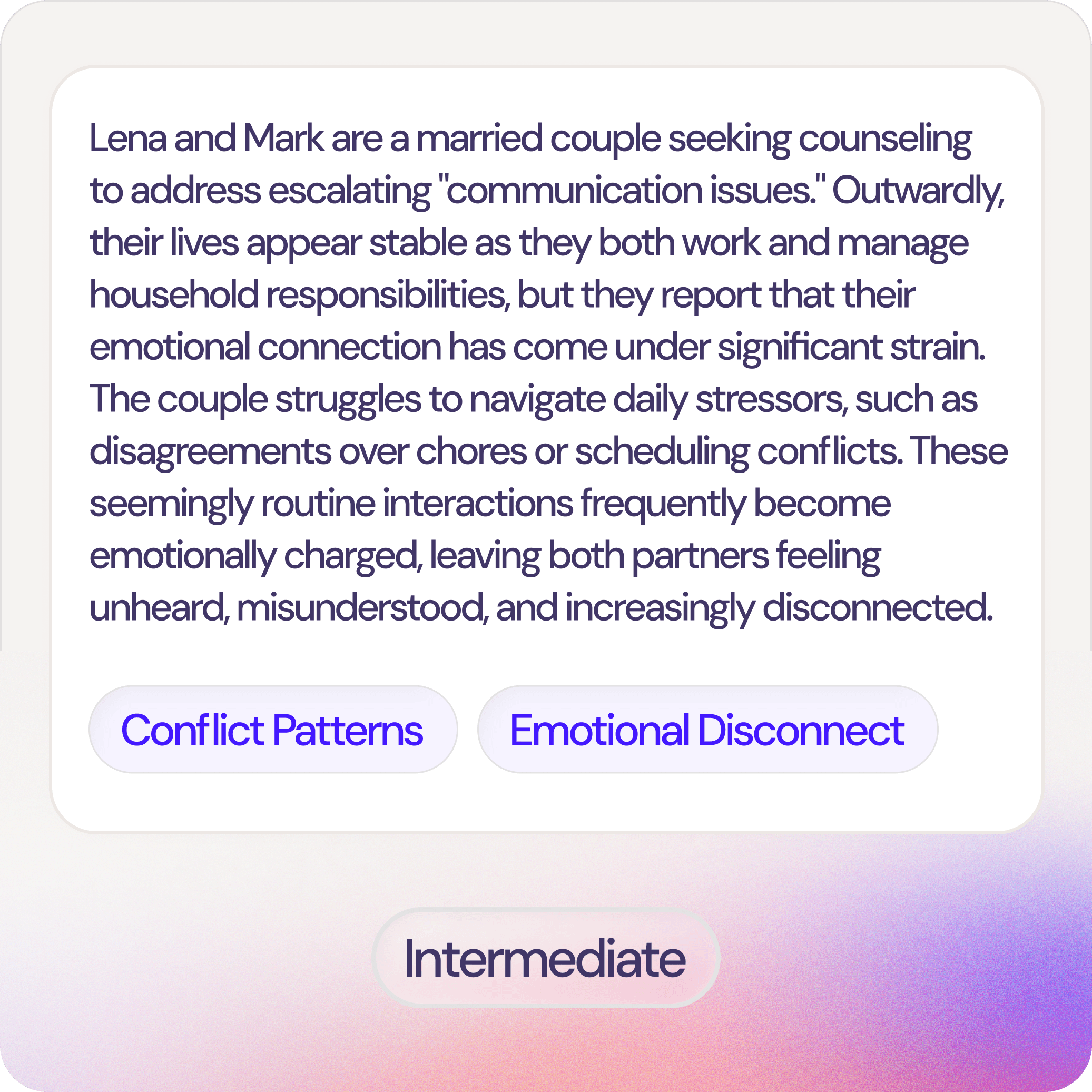
Lena and Mark, a couple in their late 30s, have been together for eight years. Recently, their arguments escalate quickly, often about “small things” like chores or scheduling. In session, Lena complains that Mark “never listens” and “shuts down.” Mark admits he withdraws but says it’s because “nothing I do is ever good enough.” Stay present and empathic without taking sides. Reflect not only the content (“you feel unheard”) but also the deeper meaning (“this feels like proof you don’t matter”). Use curiosity and warmth to slow down their reactivity and point out the cycle they’re caught in (pursue/withdraw). Gently invite each partner into contact with their softer, primary emotions (hurt, fear of abandonment, longing for connection).
Opening Message
Lena: ""That’s... that's not even what I said! Did you actually hear me say the word 'failure'? Because I didn't! It just feels like... ugh, no matter how many times I literally beg you to just listen to me, you just... you shut down. Look at you, you're doing it right now! I am so exhausted always being the only one pushing for us to actually talk.""
Mark: ""Because... I mean, whenever I do try, it’s just... it's never enough for you, Lena. The literal second I open my mouth, you just tell me I’m wrong, or, uhh, I'm not doing it the right way. So... I dunno. Why even try? I can't win.""
Lena: ""See?! This! This is exactly what I mean! You just... you immediately give up! The second it gets hard, you just check out. It's like... it's like you don't even care about making this marriage work!""
Mark: ""That's not... that's not true. I do care. I just... look, I feel like I'm going to disappoint you no matter what I do here. It’s just... it's easier to stay quiet than to just keep saying the wrong things and making you more mad.""
Lena: ""I’m not looking for you to say the 'perfect' thing, Mark! I don't care about you getting it right! I just... I just want to know that you actually care enough to stay in the room with me. To just... be in it with me."""
Module 4: Emotionally Focused Therapy
Client Profile

Assignment Description
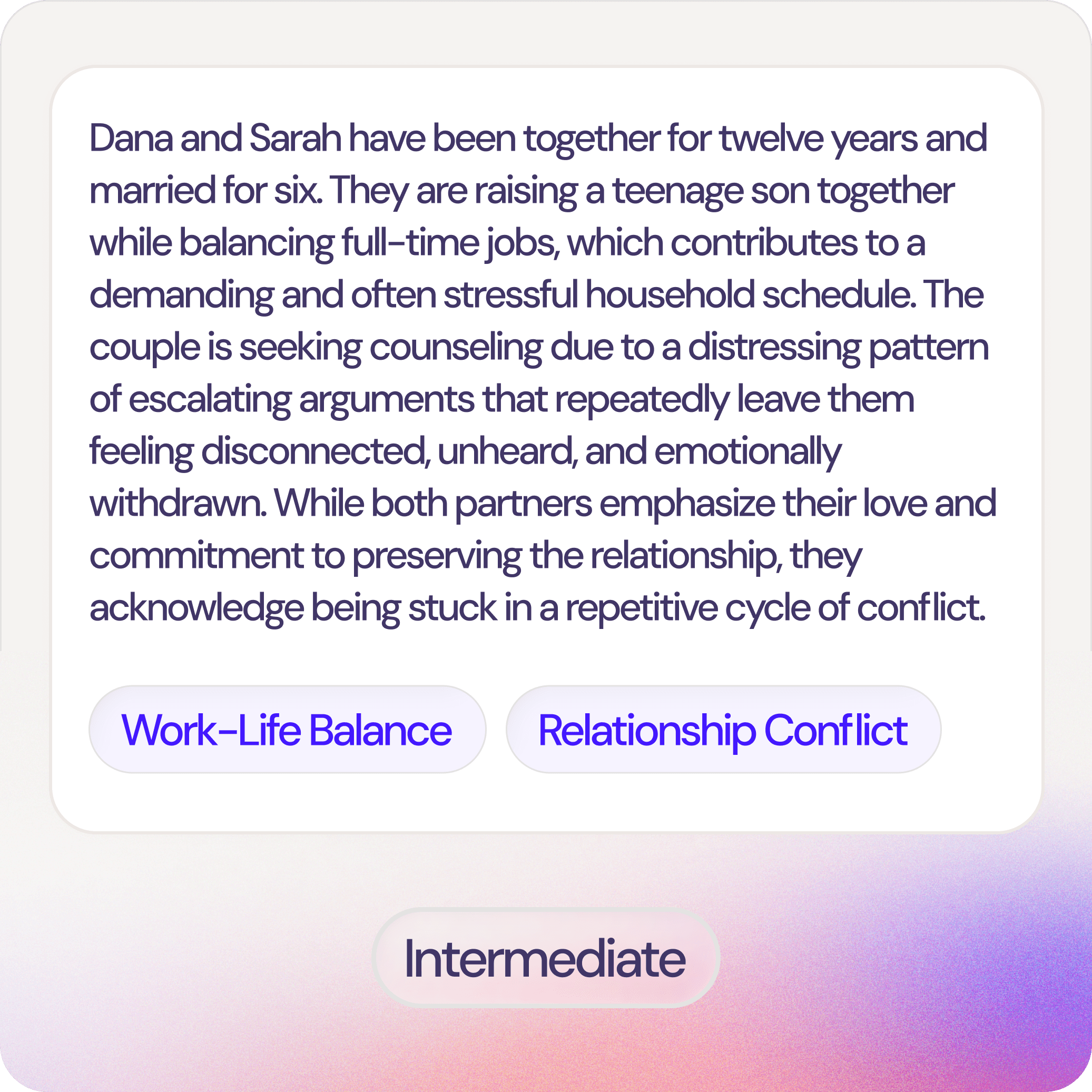
Dana & Sarah have come to counseling seeking help with frequent arguments that escalate quickly, often leaving both partners feeling unheard and disconnected. Dana often raises concerns about feeling dismissed or criticized, while Sarah becomes defensive and feels attacked, which creates a cycle of escalation. Both partners report that they love each other and want to preserve their relationship, but they feel stuck in repetitive patterns that prevent repair and intimacy. Both partners work full-time jobs and are raising a teenage son. Stress from balancing work, parenting, and their relationship has increased tension at home. They identify wanting to learn healthier communication patterns, reduce defensiveness during conflict, and reconnect emotionally.
When we lead with accusations, and make our complaints global (about our partner’s character rather than our feelings and their behaviors), it makes it challenging for others to hear us. Practice gently interrupting the argument to non-judgmentally name criticism and coach clients through a gentle startup alternative (help Dana get to the underlying emotions and needs beneath her complaint with a question about her feelings/needs, and coach her in communicating in a more gentle way “ie, “When you don’t do the dishes, I feel overwhelmed. I need more help with keeping the kitchen clean.”)
Opening Message
Dana: "It's just... you never fucking help with the dishes, Sarah. You're just... you're so lazy. It's honestly like you don't even give a shit about me or this entire relationship."
Sarah: "Are you... are you fucking kidding me right now?! How can you sit there and call me lazy when I literally spent this entire past weekend cleaning the house? You're just... you're completely unreasonable, Dana. Nothing is ever enough for you."
Dana: "Oh, right, the weekend. Look, when I walk into the kitchen and there's just a mountain of your dishes, I feel completely overwhelmed. But honestly? I wasn't even surprised this morning. I walked right by the sink and just thought... whatever. It is so pointless to expect you to do anything you actually say you're going to do. You're just... you're hopeless."
Sarah: "I didn't do them because I was rushing this morning! I just... I fucking forgot! And you know what? I'm the one who always takes out the trash! I think I've seen you take the bins out maybe... once? In our entire twelve-year relationship! But sure, I'm the hopeless one."
Dana: "Can we... can we please just stick to the dishes? Jesus. I feel so overwhelmed trying to manage every single thing in this house, and I just... I need us to find a way for you to actually participate more.""
Module 5: Relational & Attachment Trauma
Client Profile

Assignment Description
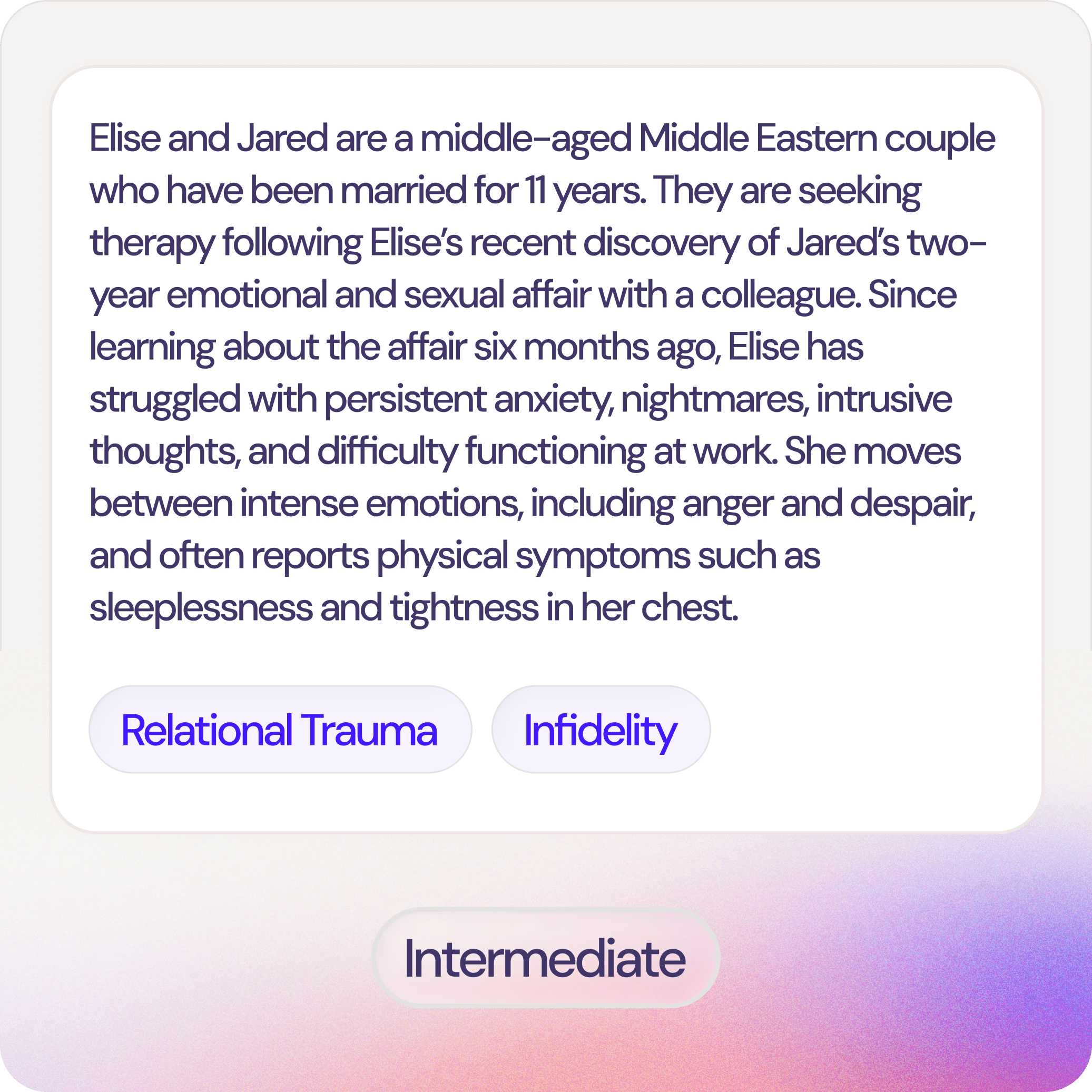
In this simulation, you will step into the role of the therapist working with Elise and Jared, an interracial married couple navigating the aftermath of Jared's two-year emotional and sexual affair. Six months after disclosure, Elise presents with trauma-like symptoms, including intrusive images, hypervigilance, and intense emotional reactivity, while Jared expresses remorse and a strong desire to repair the relationship but feels helpless in response to Elise’s anger and despair. Your task is to center the betrayed partner’s experience while maintaining awareness of the broader couple dynamic and demonstrating cultural sensitivity, inclusive language, and process-oriented curiosity.
Opening Message
Elise: "Ugh... I mean, my whole body is just... it's on edge every single second. I can’t sleep because I see you with her... that fucking bitch... I see it in my dreams, Jared. Even when you just... like, walk into the room, my chest gets so tight I can't breathe. I don't even know who I am anymore. I'm just... I'm a mess because of you."
Jared: "Look, I’ve told you... I'm so sorry, Elise. I ended it. I’ve done everything I can, okay? I don't know what else to say or do... to prove that I want us. I’m telling you, I'll never do this again. I’m right here."
Elise: "Don't. Just... don't touch me. It doesn’t stop! My mind won’t let me forget the shit you did while I was sitting at home. I feel like I’m losing my mind... and you just want me to move on like nothing happened? Like you didn't spend two years lying to my face?"
Jared: "I don’t want you to feel this way, alright? I just... I don't know how to help when every time I try, it’s like... I’m just making it worse. I feel helpless, Elise. I’m trying to fix this and you won't even let me breathe."
Elise: "Helpless? You think you’re the one who’s helpless? You blew up my entire world, Jared! Every goddamn day I wake up wondering if the last eleven years were just a lie. That’s not a mistake... that’s a betrayal. You were coming home to me after being inside her. It’s... it’s sick."
Jared: "I know! And I f-fucking hate myself for it, okay? I hate what I did. But when you get so angry and... and mean... it feels like I’ll never be forgiven. I don't even know if we can come back from this if you're just gonna hate me forever."
Elise: "I don’t even know if I want to forgive you right now. Honestly? Some days I just want to run... to get away from your face and all of this. Other days... I guess I miss what we had. But right now... I just look at you and feel like I’m gonna throw up.""
Module 6: Relational & Attachment Trauma
Client Profile

Assignment Description
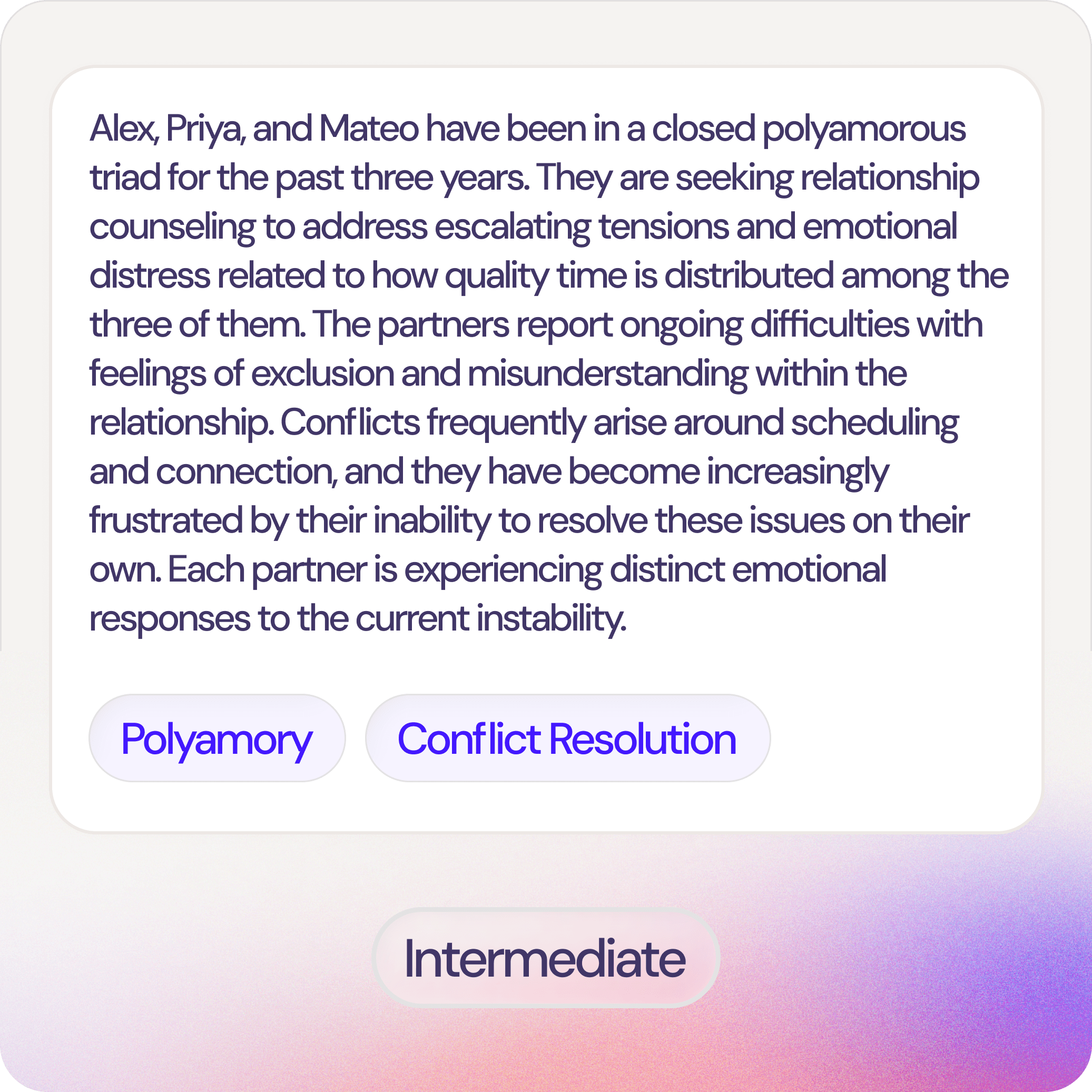
Alex, Priya, and Mateo have been in a closed triad for three years. Recently, Priya has felt increasingly left out when Alex and Mateo spend time together. Priya worries she’s the “third wheel” and fears the other two are drifting closer without her. Alex feels caught in the middle, trying to reassure Priya while also defending his connection with Mateo. Mateo becomes defensive, insisting that nothing is wrong, but underneath admits he fears losing both partners if there’s too much conflict.
Practice reflecting feelings and meaning, pointing out systems dynamics such as triangulation, helping clients access softer emotions, and attending to each partner (don’t leave out Alex!).
Opening Message
Priya: "I just... I feel like literally every single time you two make plans, I’m just left out. It’s like you don’t even notice or... or even think about me when you’re deciding what to do. I'm just an afterthought."
Mateo: "That’s... that's just not true, Priya. We don’t leave you out on purpose. Sometimes it just... it just happens! And honestly, I feel like no matter what we actually do, it’s just never good enough for you. I can't win."
Priya: "See?! This! This is exactly what I mean! You just... you immediately get defensive instead of just listening to me! I am telling you I feel invisible right now, and you're just making it about you!"
Alex: "Guys, please... Priya, we really don’t want you to feel left out. It’s... it's really not intentional. Just... please go easy on him. And Mateo, look, she just... she just needs some reassurance right now, okay?"
Mateo: "Alex, I don’t know what else she needs to hear from me! I’ve already told her, like, a million times I’m not trying to leave her out. Priya and I just... we like doing different things sometimes, and it just works out this way. It's not a personal attack."
Priya: "I don't care about the activities! I just... I just want to feel like I actually matter equally in this relationship. That I’m not just... some second choice when Alex isn't around."
Mateo: "I... I don’t want you to feel that way. You know you’re not a second choice. I just... I don't know how to fix this when you're so upset."
Alex: "See? Look... we all want the exact same thing here. We just want to feel connected and... and seen. Right? We're all on the same team, guys. We can figure this out.""
Module 7: Working with Common Sexual Concerns in Relationships
Client Profile

Assignment Description
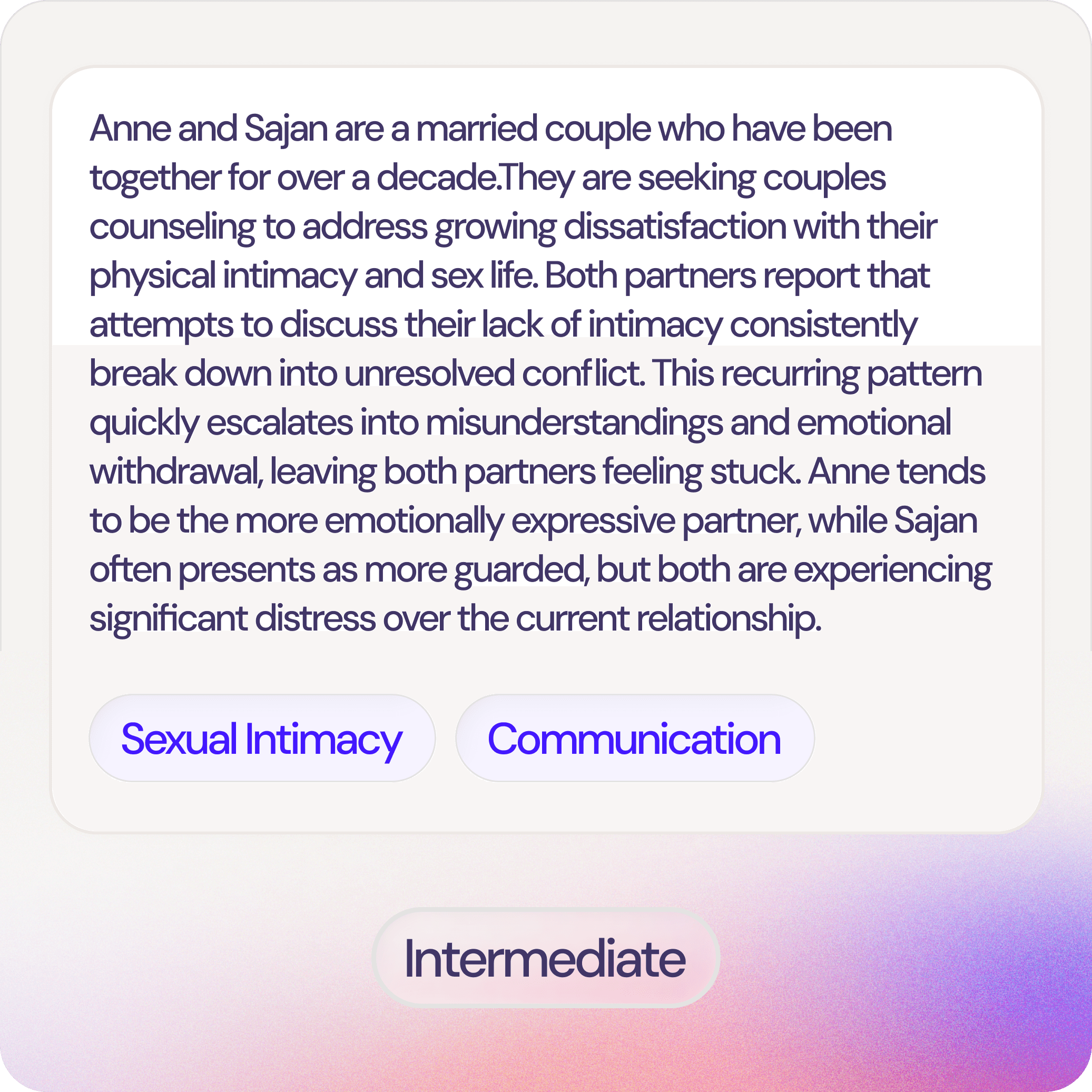
In this module, we will explore how desire discrepancy shows up in couples counseling, and practice holding space for conversations about sex. Long term relationships often include a change in frequency and quality of sexual experiences, and this is framed as an atypical issue in our society, when in reality, it is quite common. Counselors must learn to notice patterns in pursuit/withdrawal dynamics when it comes to sex and initiation, and help clients explore needs, meaning making, and primary emotions in the context of their sexual relationships.
The goal of this exercise is to practice balancing systemic awareness with moment-to-moment emotional attunement. Students will learn to track relational patterns in the triad while also helping each partner access and express their softer emotions.
Anne & Sajan, married couple who just started therapy. They've come because they're experiencing a desire discrepancy.
Model
- Reflect both Anne’s longing for connection and Sajan’s feelings of pressure and exhaustion.
- Normalize the reality of desire discrepancy.
- Capture both partners’ emotional realities and the significance sex holds for them.
- Introduce curiosity about the imbalance of household responsibilities as part of the system impacting intimacy.
Things to Think About Before Recording:
- Use systemic awareness to connect sexual desire to other relational imbalances (stress, chores, emotional labor).
- Try language like: “It sounds like sex represents... What do you both notice as you hear each other share?”
- Explore the emotional meaning of sex for Anne (desire for closeness, affirmation) and the meaning of avoidance for Sajan (stress, fear of failure).
Opening Message
Anne: "I just... I don't even know how to bring it up anymore without it turning into a whole thing. It’s been almost four months, and it just feels like... like I’m living with a roommate. A roommate who doesn't even look at me."
Sajan: "Anne, that’s... that’s not fair. I look at you. I just... I’m exhausted. Between my job and then coming home to try and manage the kids and the house, I just... I don't have anything left in the tank at the end of the day."
Anne: "But it’s not just about being tired, Sajan! Everyone gets tired. It’s about the fact that you never initiate anymore. You never even reach for my hand on the couch. It makes me feel like... like you're just not attracted to me at all. Like I'm completely unwanted."
Sajan: "I never said I wasn't attracted to you. I've told you a hundred times it has nothing to do with that. It’s just... the minute I finally sit down, I can feel this... this heavy expectation from you. Like there's just one more thing I'm supposed to do, and I just... I can't."
Anne: "One more thing? Is that what intimacy with your wife is to you? Just... another chore on your to-do list?"
Sajan: "You're twisting my words. I’m just saying I’m burnt out. I don't know what magic answer you want from me right now."
Student Learning Outcomes (SLOs)
By the end of this course and its accompanying simulations, students will be able to:
Identify and name relational cycles (e.g., Pursue/Withdraw) in real-time during high-conflict sessions.
Maintain a balanced therapeutic alliance in multi-client systems without taking sides or over-identifying with one partner.
Facilitate de-escalation for couples experiencing betrayal or attachment-based injuries.
Demonstrate inclusive clinical skills when working with interracial couples, polyamorous systems, and immigrant family dynamics.