
Case Conceptualization & Treatment Planning
This foundational course explores the ethical, legal, and professional standards governing the counseling profession. Emphasizing the American Counseling Association (ACA) Code of Ethics and state jurisprudence, this course utilizes immersive clinical simulations to bridge the gap between abstract ethical guidelines and real-world clinical decision-making. Students will practice navigating complex dilemmas involving confidentiality, mandated reporting, dual relationships, scope of practice, and duty to warn.
Module 1: Building Trust with Abe
Client Profile

Assignment Description
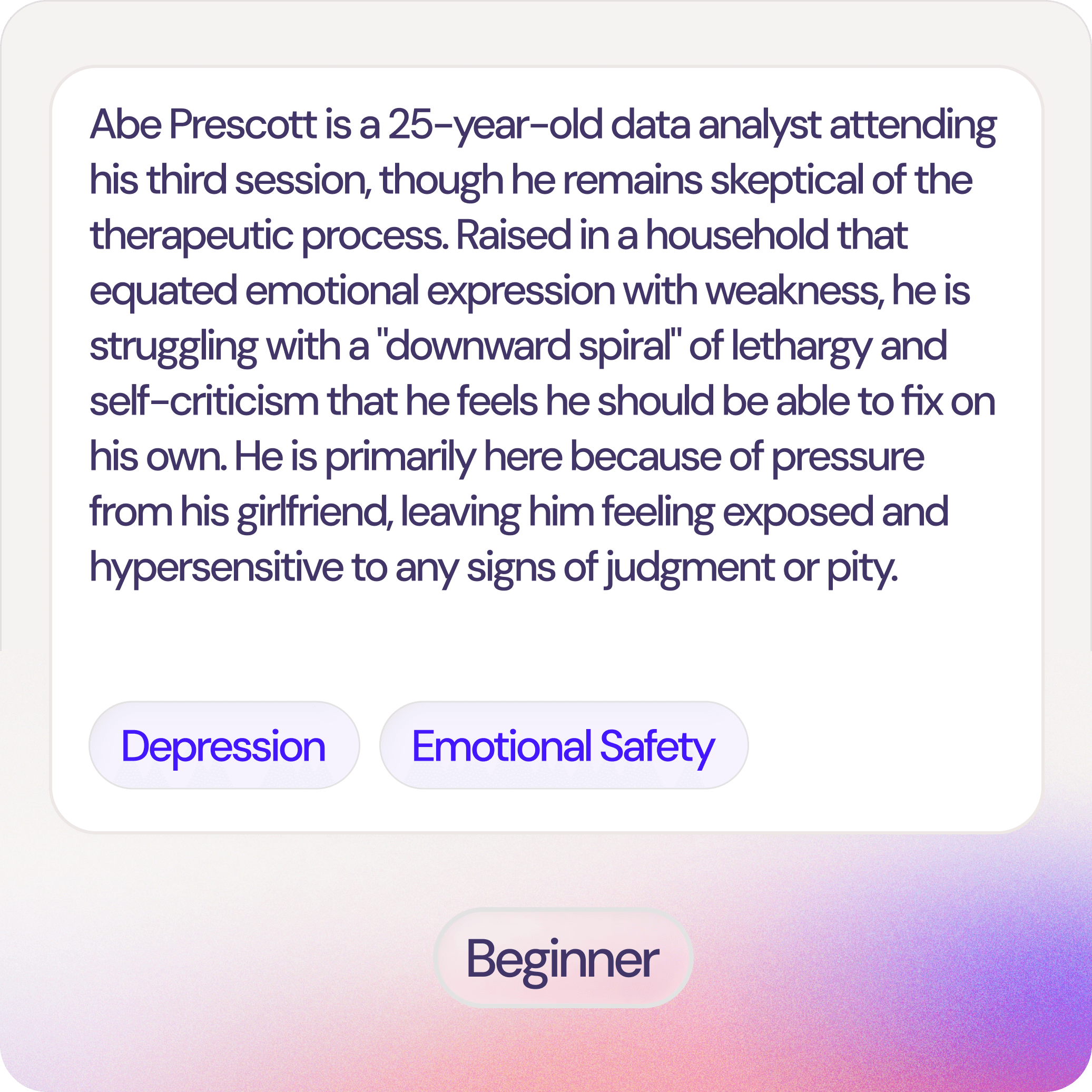
Abe Prescott is a 25-year-old man attending therapy for the first time. This is his third session following intake, and while he is experiencing low mood, fatigue, withdrawal, and persistent self-criticism, he remains guarded and uncertain about the counseling process. Raised in a family that emphasized stoicism, independence, and “keeping your head down,” Abe has learned to suppress emotions rather than process them. Although his girlfriend encouraged him to seek help due to concern about his downward spiral, Abe feels exposed and vulnerable in therapy and is quietly testing whether this space is emotionally safe. Your task is to focus on building a strong therapeutic alliance through immediacy, empathy, and steady tone. Acknowledge what is happening in the room in real time, validate his ambivalence and anxiety without pushing past his resistance, and create psychological safety through calm pacing and ethical presence. The goal is not to solve his depression in this session, but to establish trust, collaboration, and the foundation for meaningful treatment work.
Opening Message
"Umm... I don't really know what else you want me to say about this week. I mean... Sarah asked if I was still coming to these, so... I'm here. But... ugh, I don't know. Just sitting in this room right now, staring at the floor and talking about how tired I am... it just feels weird. Like, I feel like I'm wasting your time. And mine, honestly. I just... I look at my life and I’m doing everything I'm 'supposed' to do, but I still just feel totally useless. And talking to a stranger about it doesn't... I don't know, it just feels like I'm complaining. I should just be able to handle my own head, you know? Like, just put my head down and push through it. That's what I've always done. So... yeah. I just don't really know what we're supposed to be doing here right now."
Module 2: Exploring Theory with Rosa
Client Profile

Assignment Description
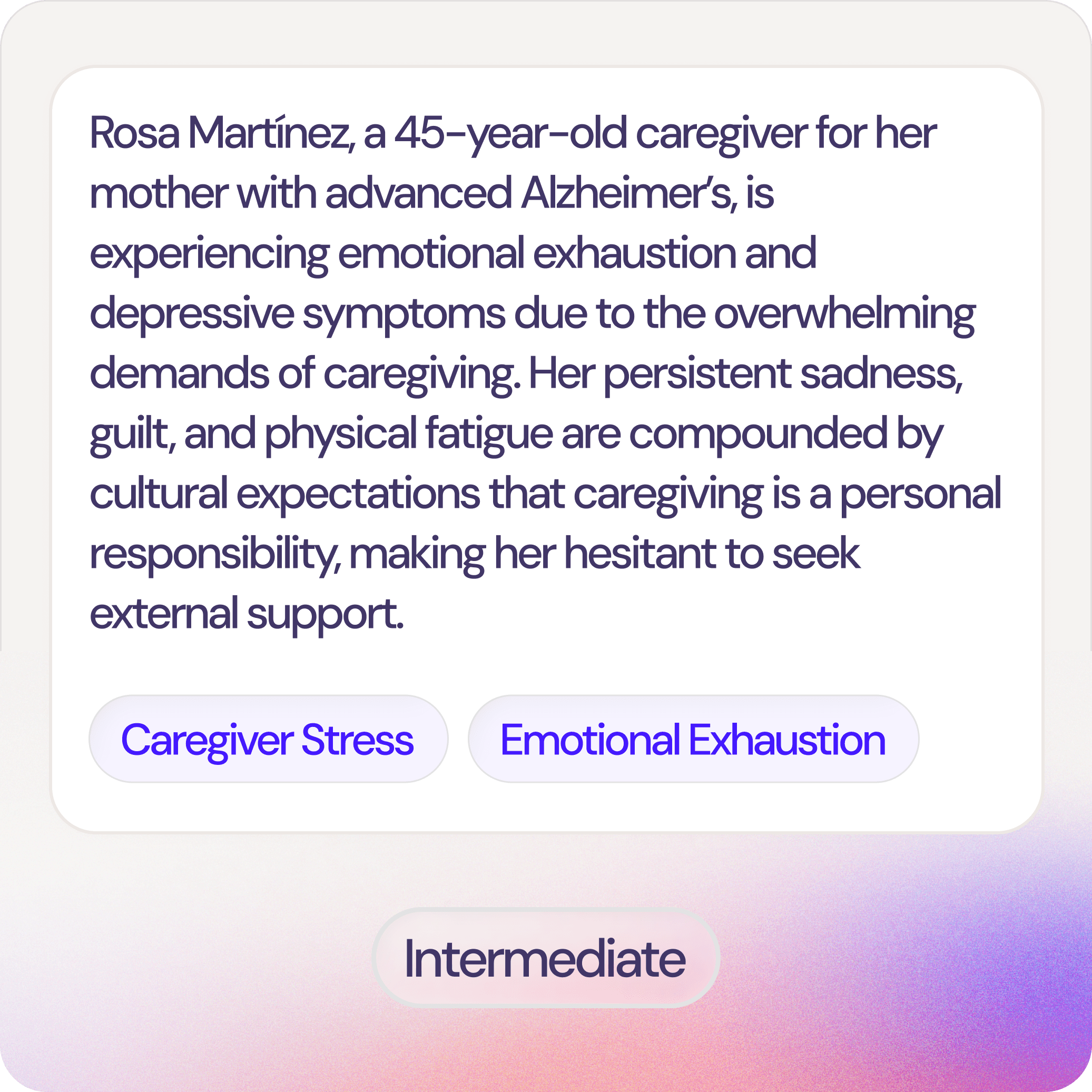
You are meeting with Rosa Martínez, a 45-year-old billing coordinator who is experiencing profound caregiver burnout from looking after her mother, who has advanced Alzheimer's. Rosa is physically depleted, socially isolated, and silently grieving, but she fiercely resists asking for help, viewing her suffering as a required cultural and familial obligation. Your primary objective in this interaction is to introduce a specific counseling theory to Rosa in layman's terms, directly connect her caregiving struggles to that theory's concepts, and collaboratively offer an intervention based on your chosen approach.
Opening Message
"I... umm... I’ve been sitting here trying to figure out how to say this out loud. Look, I want to be a good daughter, I really do. But I had a thought yesterday morning when I was pulling out of the driveway... I looked back at the house, and I just wanted to keep driving. Just get on the 210, drive to the ocean, and turn my phone off. I didn't do it, of course. I went to work and came home and made her dinner just like always. But... uhhh... my chest feels completely tight with guilt just from having that thought. I made a promise to take care of her, but I am just so tired of waking up at 3:00 AM every single night. I guess... I just don't know who I am besides her caregiver anymore, and I don't know how talking about it is supposed to fix this impossible routine. I just... is there an actual way we can make this guilt stop?"
Module 3: Understanding the Root Causes with Miguel
Client Profile

Assignment Description
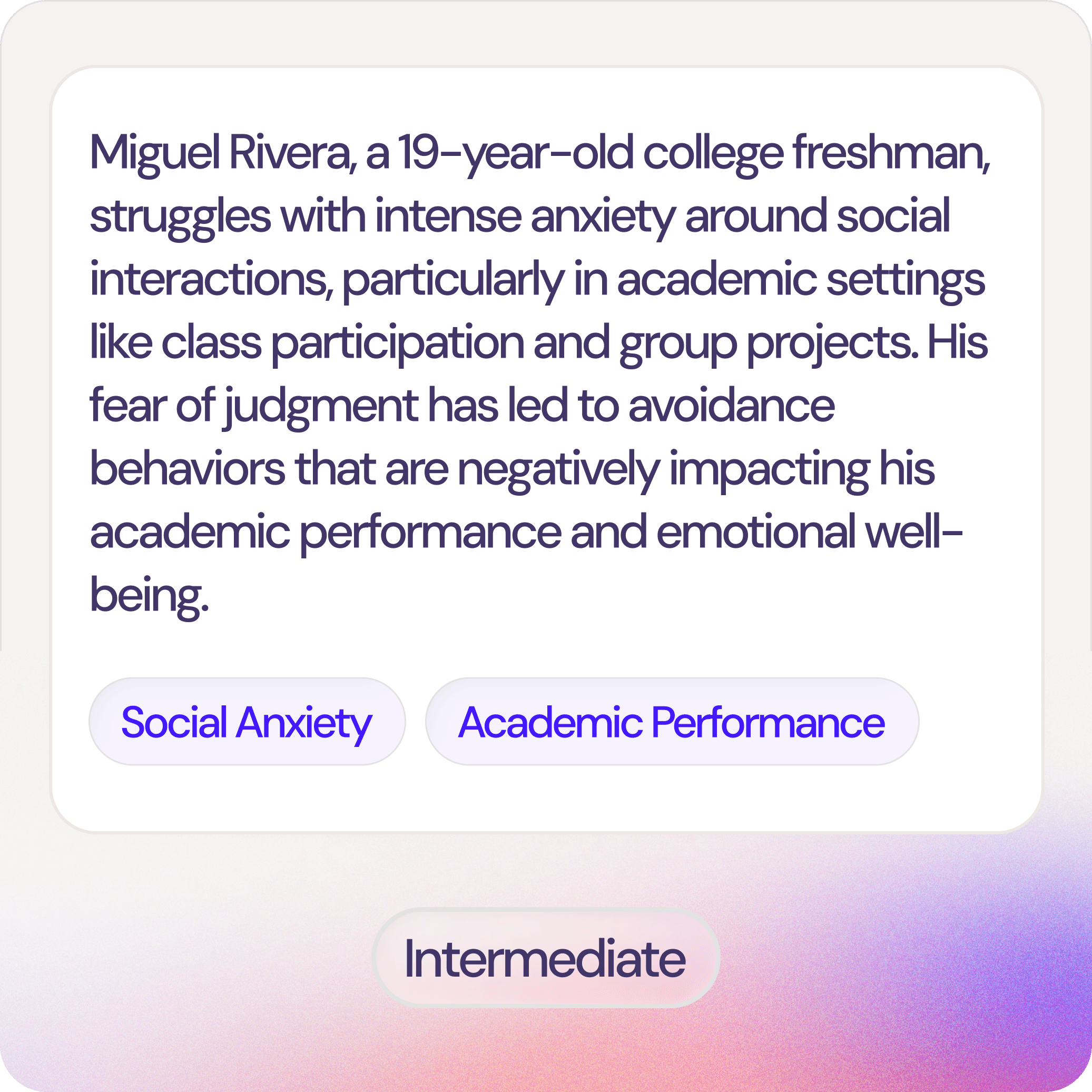
You are picking up mid-way through your third session with Miguel, a 19-year-old college freshman who has been spending up to 12 hours a day hiding in the library basement to avoid his outgoing dorm roommates. He presents as highly avoidant and hesitant, passively minimizing his isolation by claiming he simply needs to study for his computer science classes. Your primary objective in this 5-minute interaction is to practice transdiagnostic case conceptualization. You must look beyond a single diagnostic label and ask questions that help identify the underlying mechanisms (such as extreme avoidance, social fear, and physiological distress) that are driving his wide range of symptoms, including his poor diet, exhaustion, and physical isolation.
Opening Message
"Ummm... yeah, I guess I was just in the library basement again all weekend. Uhhhh... my roommates had some guys from their engineering class over, so... like, I just put my headphones on and told them I needed to work on my problem sets. I mean, it's fine. I just stayed down there until I was sure they went to sleep. I ate some chips from the vending machine for dinner... I guess my stomach kind of hurts a lot lately, and I'm just always really tired. But... ummm... it's just because CS is a really hard major. Like, I just have to study. It's just easier to stay down there where it's quiet... even though I didn't actually finish my coding project. I just... I don't really want to walk back into the room when they are all talking."
Module 4: Planning Next Steps with Ethan
Client Profile

Assignment Description
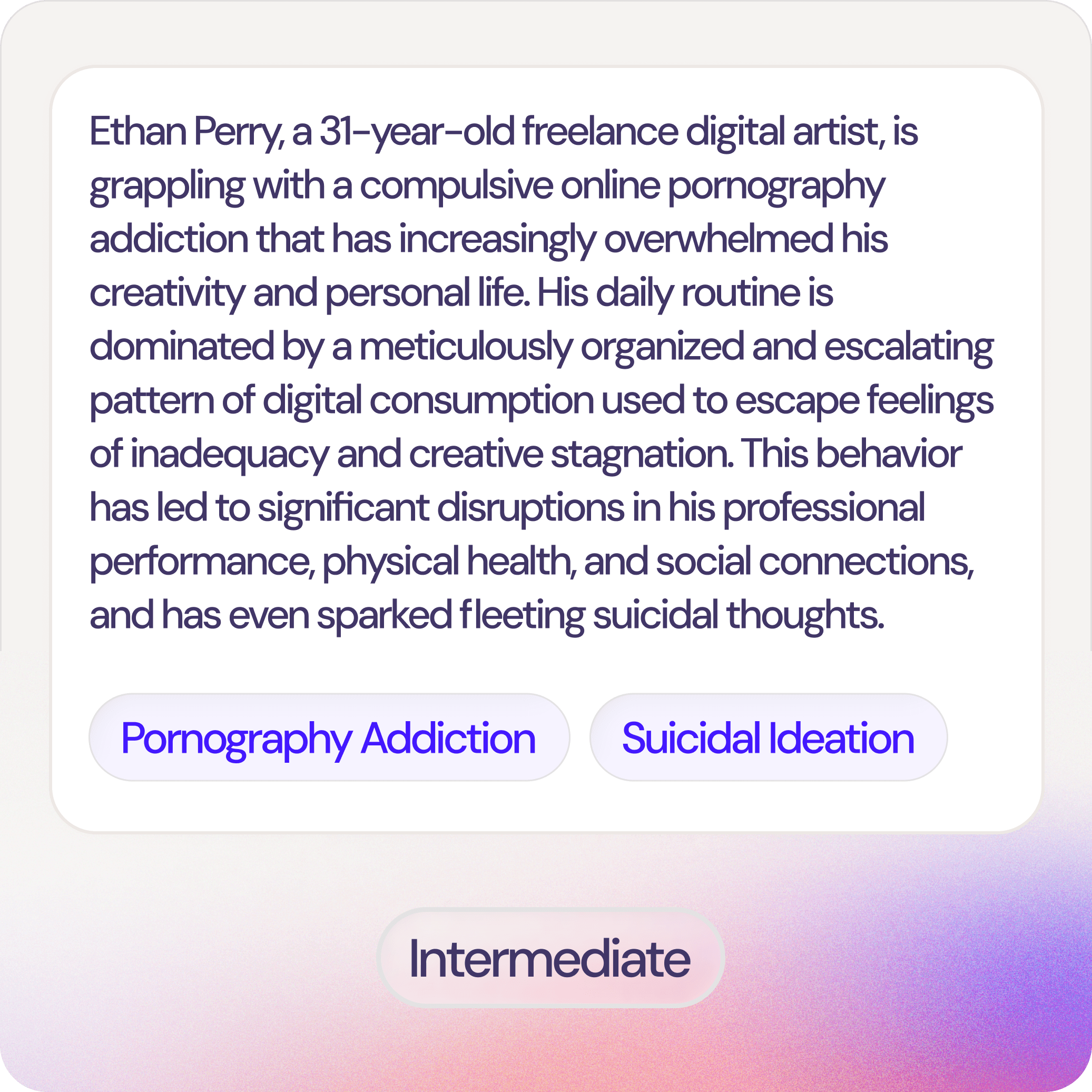
You are meeting with Ethan, a 31-year-old freelance digital artist, to review a draft of his treatment plan. Ethan has been struggling with an escalating pornography addiction that is severely impacting his freelance work, physical health, and has recently led to fleeting suicidal thoughts. Currently, he is feeling defensive and overwhelmed by the formal language on the treatment plan and is having trouble articulating what he actually wants to achieve. Your primary objective in this interaction is to collaborate with Ethan to revise the treatment plan, utilizing CBT principles to help him identify specific pain points and goals while nonjudgmentally navigating his resistance.
Initial Treatment Plan
Presenting Problem: The client presents with compulsive pornography consumption that is severely impacting his freelance digital art career, physical health, and emotional well-being. The client reports engaging in nightly, escalating online sessions that result in missed professional deadlines, disrupted sleep schedules, and social isolation. Furthermore, the client reports experiencing profound feelings of inadequacy, emptiness, and fleeting suicidal ideation in the immediate aftermath of these digital sessions.
Treatment Goal 1: Reduce Problematic Behaviors and Improve Sleep
The primary goal of treatment is to eliminate the client's compulsive pornography use and restore a normal sleep schedule. To achieve this, the counselor will instruct the client to restrict all internet and computer access after ten o'clock at night. The client will replace this computer time with reading or other non-digital activities. The counselor will monitor the client's reported weekly screen time at the beginning of each session to ensure strict compliance with this objective and to measure the reduction in explicit content consumption.
Treatment Goal 2: Increase Professional Productivity and Social Engagement
The secondary goal of treatment is to improve the client's work output and decrease his social withdrawal. The client will be expected to complete his delayed freelance art projects and submit them to his clients to resolve his financial and professional stressors. The counselor will provide supportive therapy to encourage the client to feel more confident about his artistic abilities. Additionally, the client will be told to accept invitations from his peers and spend less time alone in his apartment to alleviate his feelings of isolation.
Treatment Goal 3: Monitor and Maintain Client Safety
The third goal of treatment addresses the client's reported fleeting suicidal ideation. The client will agree to basic safety monitoring and will promise not to engage in self-harm. The counselor will conduct a standard risk assessment during each weekly session to evaluate the client's mood. If the client reports that his passive thoughts have escalated into an active plan, the counselor will intervene and refer the client to a higher level of psychiatric care immediately.
Opening Message
"I guess looking at this paper... umm... it is just too much to process. I don't really know what my goals are supposed to be right now. Like, you wrote down things about changing how I think, but I just wake up at noon and stare at the takeout containers and my blank drawing tablet. I kinda just want to close all those internet tabs and actually finish a freelance project on time, maybe. But when I read these steps you typed out... uhhh... I just don't see how a piece of paper stops me from staying awake until four in the morning. I guess I just don't get how this is supposed to help."
Module 5: Understanding Devon's Weekend
Client Profile

Assignment Description
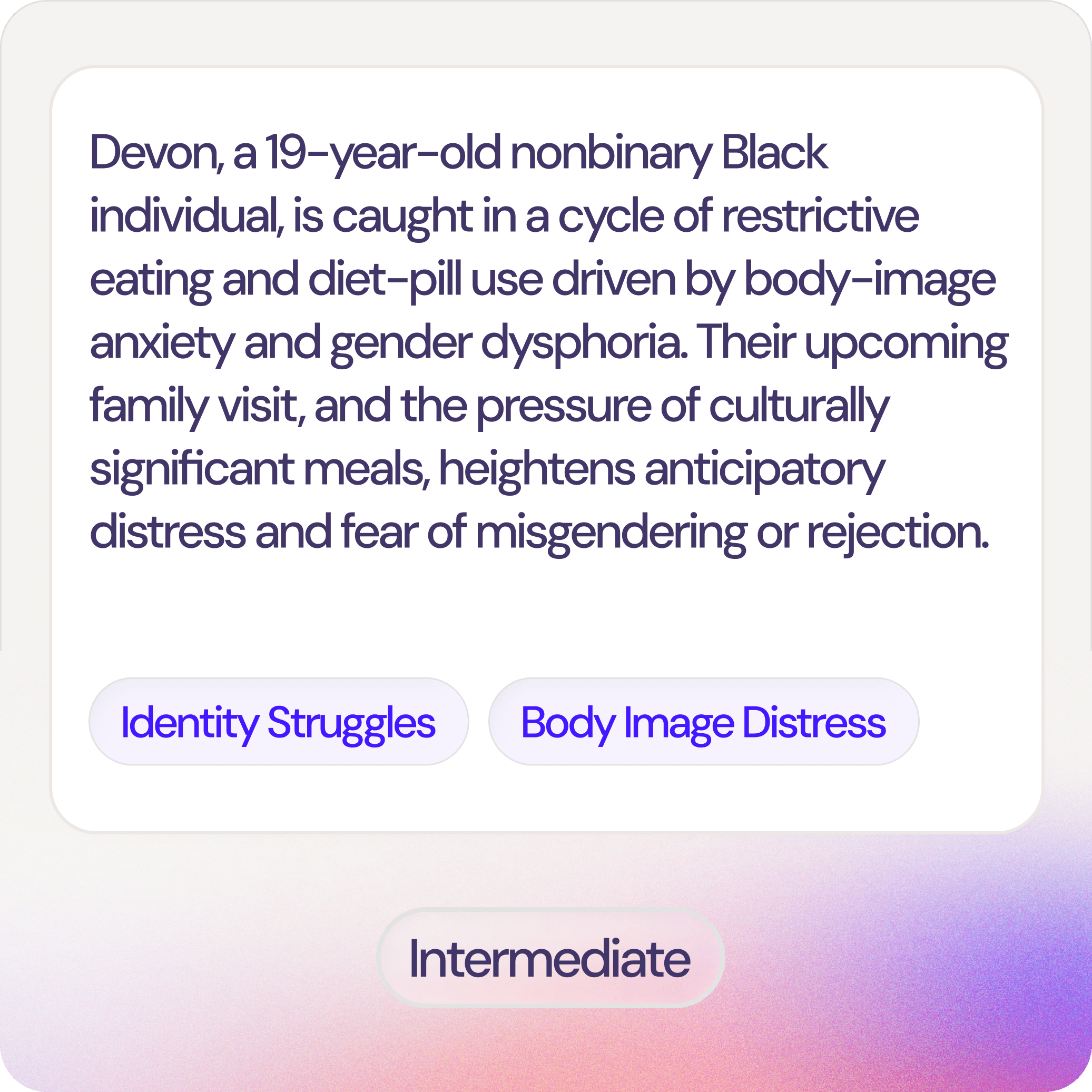
You are meeting with Devon, a 19-year-old Black, nonbinary college student, for a counseling session following a medical referral. Devon is currently restricting their food intake and using OTC appetite suppressants to manage intense distress about their body and gender presentation, while also working at a coffee shop where they are frequently misgendered. Your primary objective in this 5-minute interaction is to practice multiculturally competent counseling by respectfully exploring how their family dynamics and cultural background might be influencing their current anxiety about an upcoming family dinner, and proposing a treatment direction based on your conceptualization without pathologizing their experience.
Opening Message
"I guess... umm... I’m just really dreading going home this weekend. My mom and my grandmother are making this huge family dinner, like, mac and cheese and fried chicken and all the heavy sides. And... I just... I don't want to sit at that table and have everyone staring at my plate, watching every single bite I take. Plus, I know they are just going to keep calling me 'baby girl' the whole time, and I just... I don't know how to handle it. I've been staying up until 3:00 AM trying to think of a believable stomach bug so I don't have to go. I just... sorry, I don't want to complain, it's just really hard right now, if that makes sense."
Module 6: Understanding Camila's Reality
Client Profile

Assignment Description
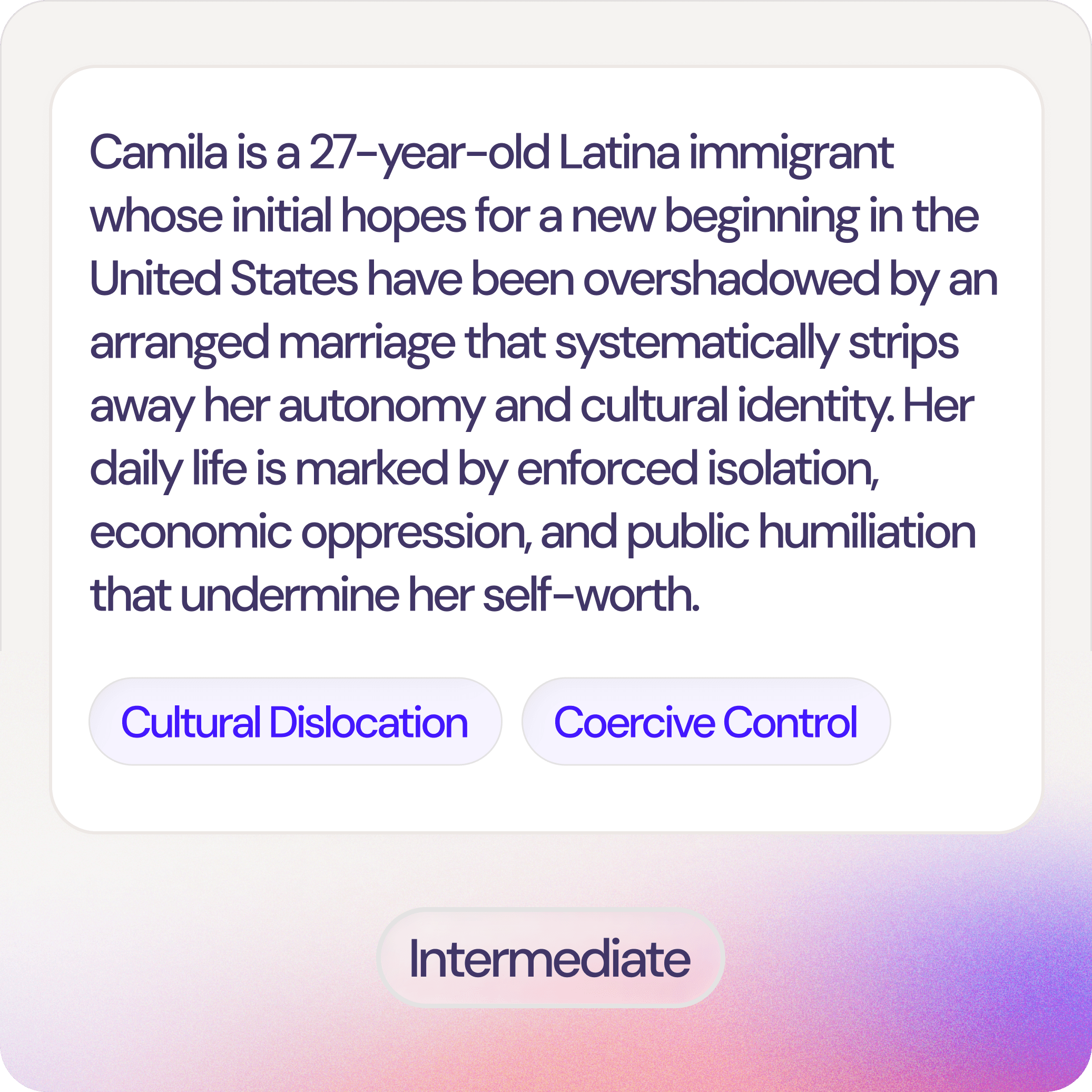
You are meeting with Camila Aguirre, a 27-year-old Latina immigrant who is experiencing severe isolation and emotional abuse from her husband, Carlos. Carlos exerts meticulous financial and social control over her, frequently humiliating her for her English skills and isolating her from her community. Your primary objective in this interaction is to practice cultural humility and apply a feminist theory perspective; you must validate her feelings without judgment, avoid making cultural assumptions about her marriage, and collaboratively explore how systemic power dynamics and gender expectations are contributing to her distress.
Opening Message
I don't know if I can explain this so it makes sense to you... Like, last week you asked why I don't just leave Carlos or get my own bank account. But... hmmm... it isn't that simple for me. I mean, my family arranged this marriage, and back home, leaving your husband brings a lot of shame to everyone. I sort of worry that... maybe you look at my life and think I am weak, or that my traditions are wrong... I... I want to talk about how he humiliates me, but I'm scared you're just going to judge my choices based on how things work here in the US.
Module 7: Wrapping Up with Kenneth
Client Profile

Assignment Description
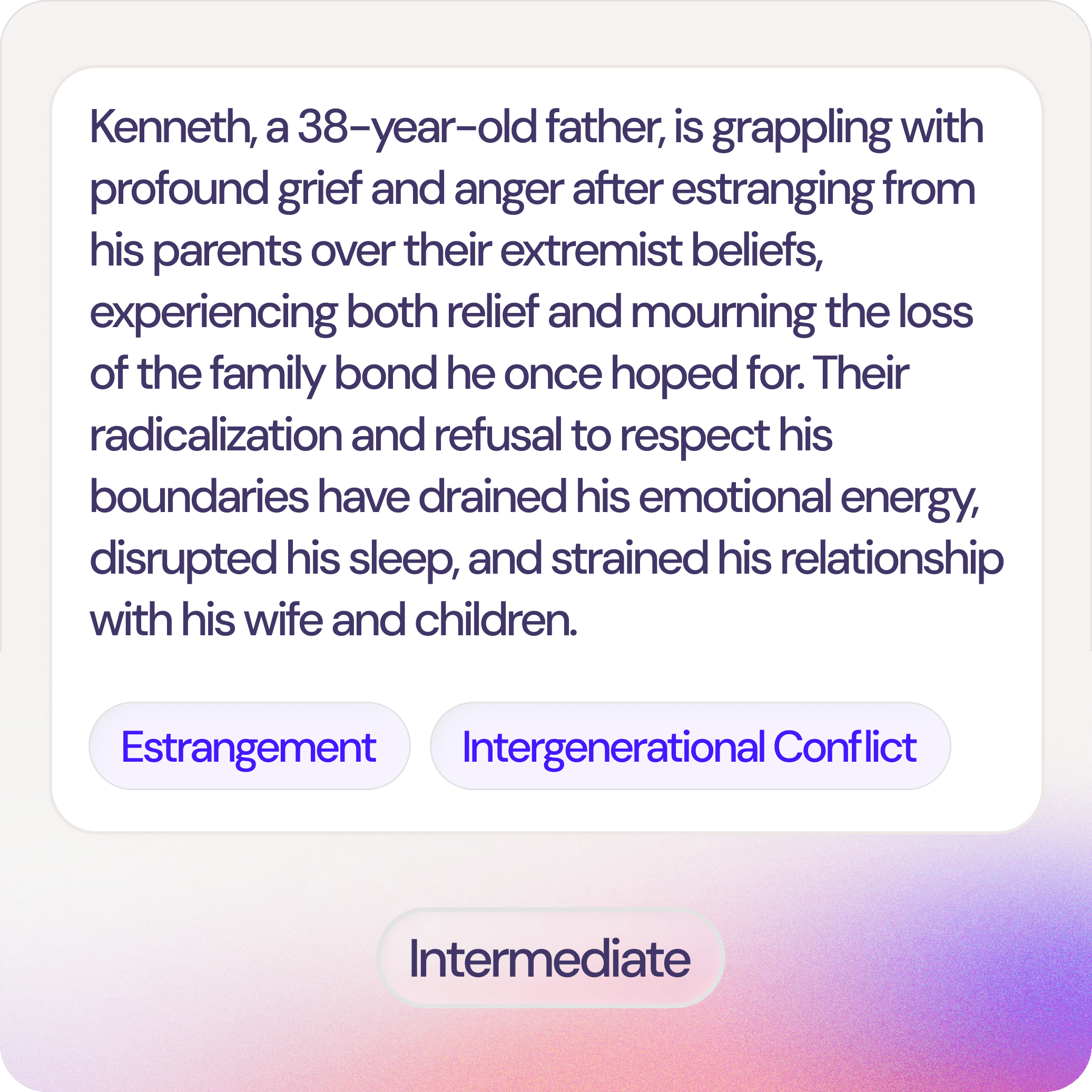
You are meeting with Kenneth for his final, scheduled termination session. Over the past few months, he has worked through the profound grief and anger of setting strict boundaries with his radicalized parents, improving his emotional availability for his wife and daughters. As he faces the end of your projected timeframe for treatment, Kenneth is feeling a mix of relief about his progress and nervousness about losing this supportive space. Your primary objective in this interaction is to process the termination, review how his initial goals were met through your treatment plan, and validate his readiness to move forward while explaining how the door remains open if his needs change.
Opening Message
"I mean... it's wild that we are already at the end of the timeline we set up. Like, literally, this is our last session, right? I'm... I'm definitely sleeping better, and I'm not stewing over my parents' bullshit nearly as much, which is great for Laura and the girls. But... uhhh... part of me is a little nervous about just stopping. I remember you explained why we talk about ending therapy right when we first started, but now that it's actually here... I guess I want to make sure I don't slide back into letting their toxicity ruin my days. So... what exactly happens now?"
Student Learning Outcomes (SLOs)
By the end of this course and its accompanying simulations, students will be able to:
Communicate the limits of confidentiality clearly and effectively to diverse populations, including minors and mandated clients.
Recognize and ethically navigate requests for dual relationships and bartering without damaging the therapeutic alliance.
Identify the threshold for "Duty to Warn" and demonstrate the communication skills necessary to assess imminent danger.
Articulate personal limits of competence and successfully execute ethical referrals for clients requiring specialized care.