
Substance Use and Addiction
This clinical course provides a comprehensive examination of the etiology, neurobiology, and treatment of substance use disorders (SUDs) and process addictions. Moving beyond theoretical models, this course utilizes realistic clinical simulations to train students in evidence-based interventions, with a heavy emphasis on Motivational Interviewing (MI), harm reduction, and trauma-informed care. Students will practice navigating complex co-occurring disorders, mandated treatment resistance, suicide risk assessment, and cross-cultural considerations in addiction recovery.
CACREP 2024 Standards Alignment Mapping
Primary CACREP Core Area: Counseling Practice and Relationships (Core Area 5) & Specialized Addiction Studies This course is specifically targeting foundational knowledge of addictive behaviors and applied evidence-based counseling strategies.
Standard 2.B.3.d: Theories and etiology of addictions and addictive behaviors.
Assessed via: Rami's simulation (process addictions) and Bob's simulation (physiological opioid dependence).
Standard 2.B.5.f: Essential interviewing, counseling, and case conceptualization skills.
Assessed via: All simulations, specifically evaluating the student's mastery of OARS and complex reflections.
Standard 2.B.5.g: Evidence-based counseling strategies and techniques for prevention and intervention.
Assessed via: Modules 2, 4, 5, 6, and 7, directly assessing the fidelity of Motivational Interviewing (MI) application.
Standard 2.B.1.d: Ethical standards... and applications of ethical and legal considerations.
Assessed via: Dylan's simulation (minor confidentiality) and Luis's simulation (mandated reporting limits).
Module 1: Earning Dylan's Trust
Client Profile

Assignment Description
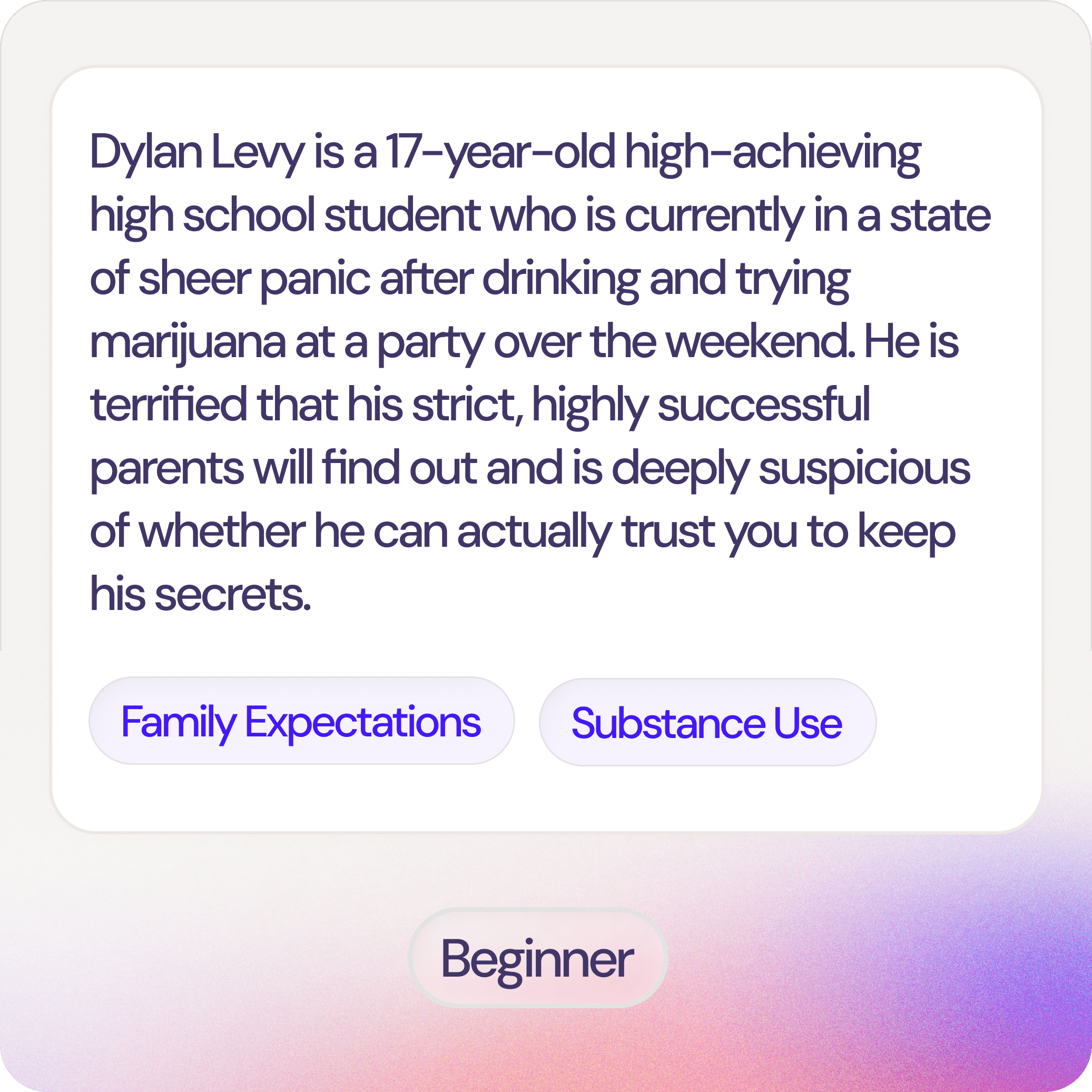
You are stepping into the first session with Dylan Levy, a 17-year-old, high-achieving high school student who is currently in a state of sheer panic after drinking and trying marijuana at a party over the weekend. He is terrified that his strict, highly successful parents will find out and is deeply suspicious of whether he can actually trust you to keep his secrets. Your primary objective in this 5-minute interaction is to use a calm, steady tone to de-escalate his anxiety and use immediacy to address the palpable tension in the room. You will need to validate his intense fear of disappointing his family while clearly and ethically explaining the rules of confidentiality to establish psychological safety.
Opening Message
"So, like... before I actually say anything else about the party... I mean... I just need to know the actual rules here. Because... umm... yeah no, my dad is a lawyer, and he says there are always exceptions to confidentiality. So... if I tell you that I did something illegal... like, drinking or smoking... do you have to report that? Because... uhhh... my leg will not stop bouncing right now, and I'm just freaking out that you're going to call my parents the second I walk out that door. I mean... I've never done anything like this before. Basically... if they find out, I lose my car, I lose my early admissions... I just... I can't let them look at me like I'm a failure. So, like... what exactly stays in this room?"
Module 2: Respecting Autonomy
Client Profile

Assignment Description
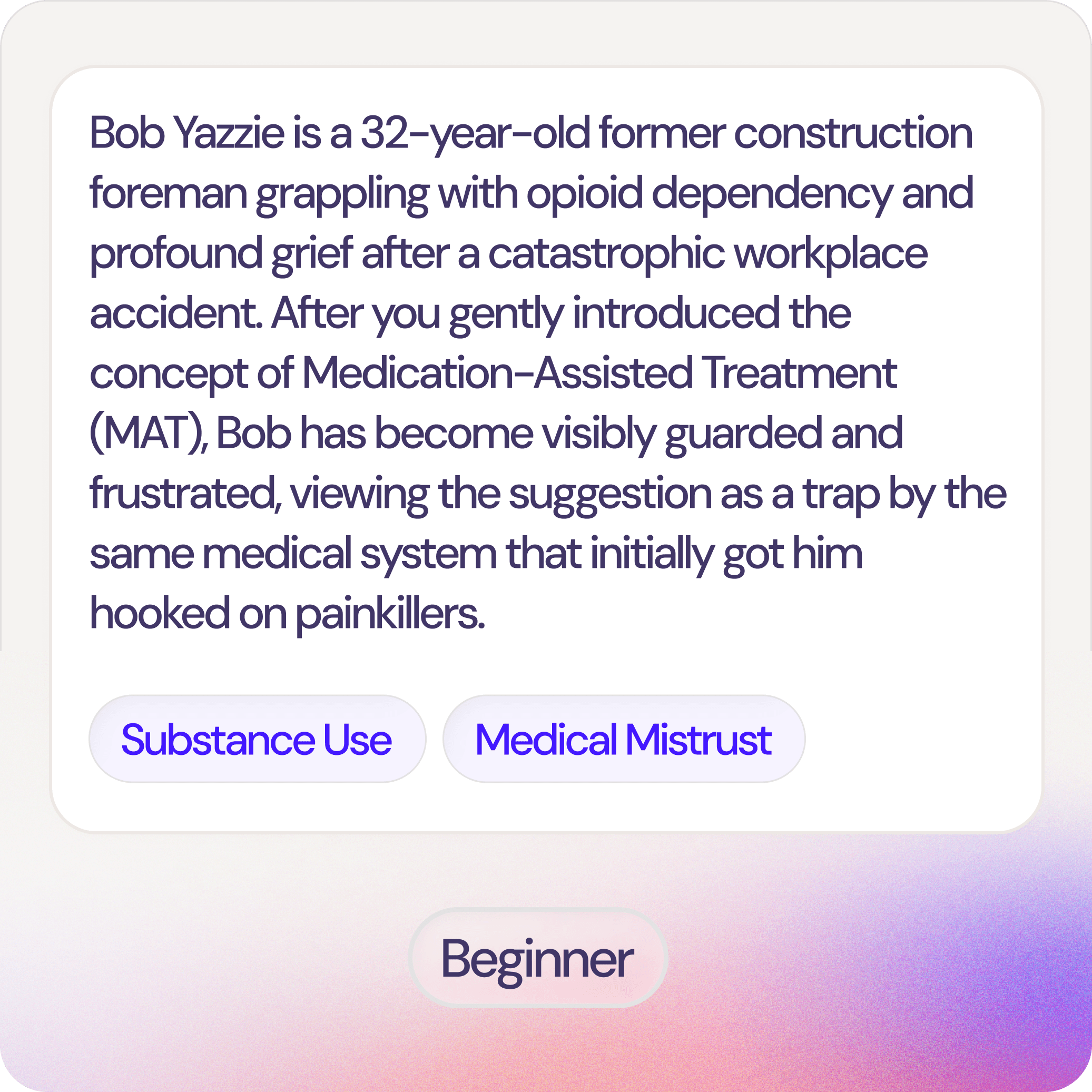
You are picking up mid-session with Bob Yazzie, a 32-year-old former construction foreman grappling with opioid dependency and profound grief after a catastrophic workplace accident. After you gently introduced the concept of Medication-Assisted Treatment (MAT), Bob has become visibly guarded and frustrated, viewing the suggestion as a trap by the same medical system that initially got him hooked on painkillers. Your objective in this interaction is to practice the Motivational Interviewing spirit of PACE (Partnership, Acceptance, Compassion, Evocation) to navigate his resistance. You must validate his deep desire for autonomy and collaborate with him to explore what recovery looks like on his own terms, without arguing or pushing the medication.
Opening Message
"Listen, man... I just... uhhhh... I don't want to hear about another pill. Look, the docs at the clinic are the ones who put me on this stuff in the first place after the crane fell. They handed me the bottles, told me it would fix my back, and then just cut me off when I couldn't even stand up straight yet. And now you're telling me I need to go to another clinic to get a different chemical just to get through the day? Hell, that’s just trading one drug for another. I mean... ummm... I came here because I want to be completely clean. Zero substances in my blood. I want my strength back. I want to wake up at 3 AM and not hear that metal snapping, and I need to do it standing on my own two feet. Relying on some new doctor's prescription... it is what it is, but it’s not fixing the real problem. I don't get why you can't just help me figure out how to stop taking everything right now."
Module 3: Sitting with Reid
Client Profile

Assignment Description
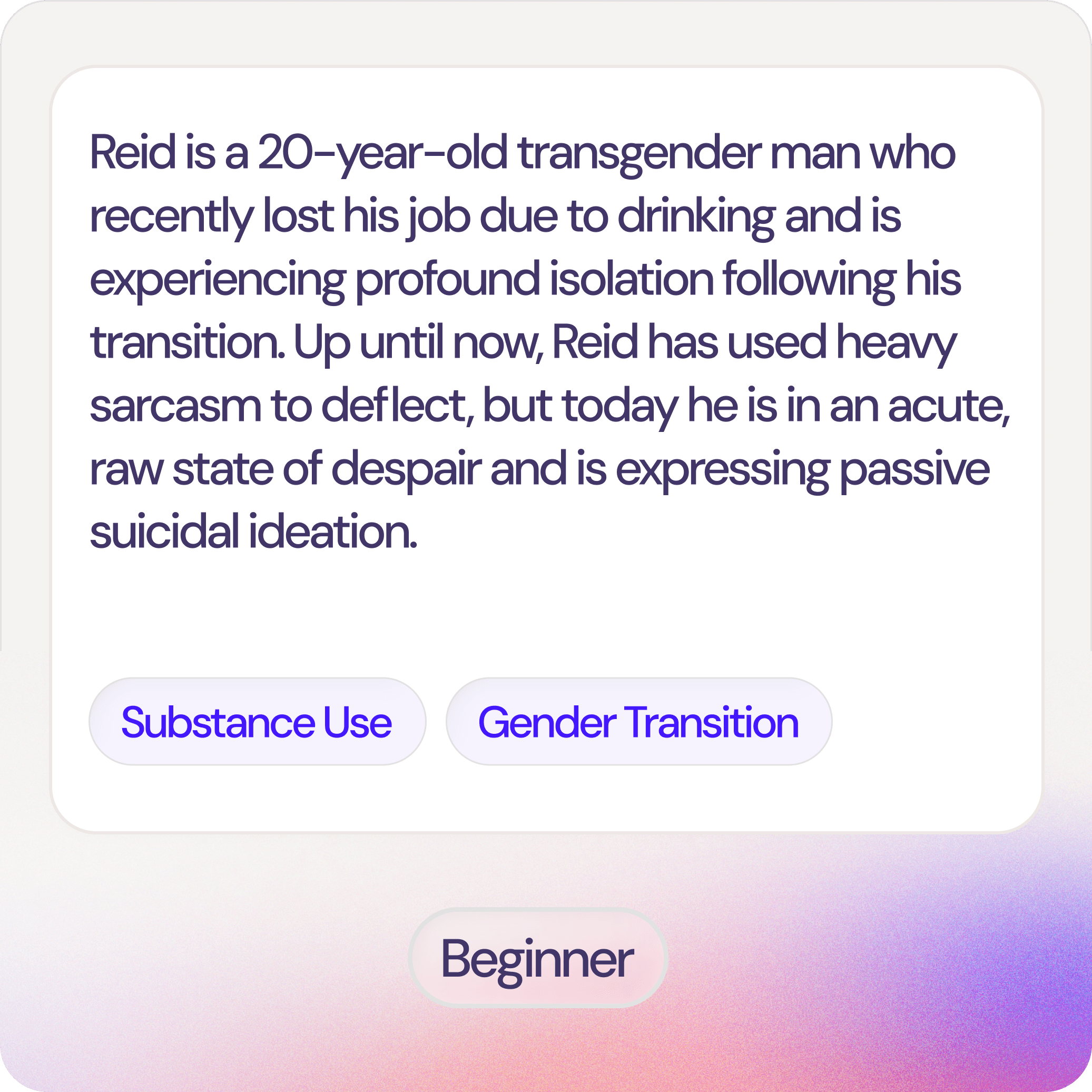
You are entering your sixth session with Reid, a 20-year-old transgender man who recently lost his job due to drinking and is experiencing profound isolation following his transition. Up until now, Reid has used heavy sarcasm to deflect, but today he is in an acute, raw state of despair and is expressing passive suicidal ideation. Your objective in this 5-minute interaction is to use the OARS skills (Open-ended questions, Affirmations, Reflective listening, Summarizing) to stay grounded in his pain, validate his vulnerability, and de-escalate the crisis through deep emotional presence rather than trying to "fix" his situation.
Opening Message
"Yeah no, I mean... my coping skills are just thriving right now, obviously. But... uhhhh... I don't know. I'm just so tired today. I lost my job because I couldn't wake up, and my apartment is a mess, and... I just feel like garbage. I keep looking out the window at the traffic and thinking... like... my mom wouldn't have to deal with me anymore if I just stepped out there. I'm not going to do it. I'm just... I feel empty. I don't see the point in trying anymore because nobody actually wants me around anyway. I'm just a burden. Whatever."
Module 4: Goal Setting with Luis
Client Profile

Assignment Description
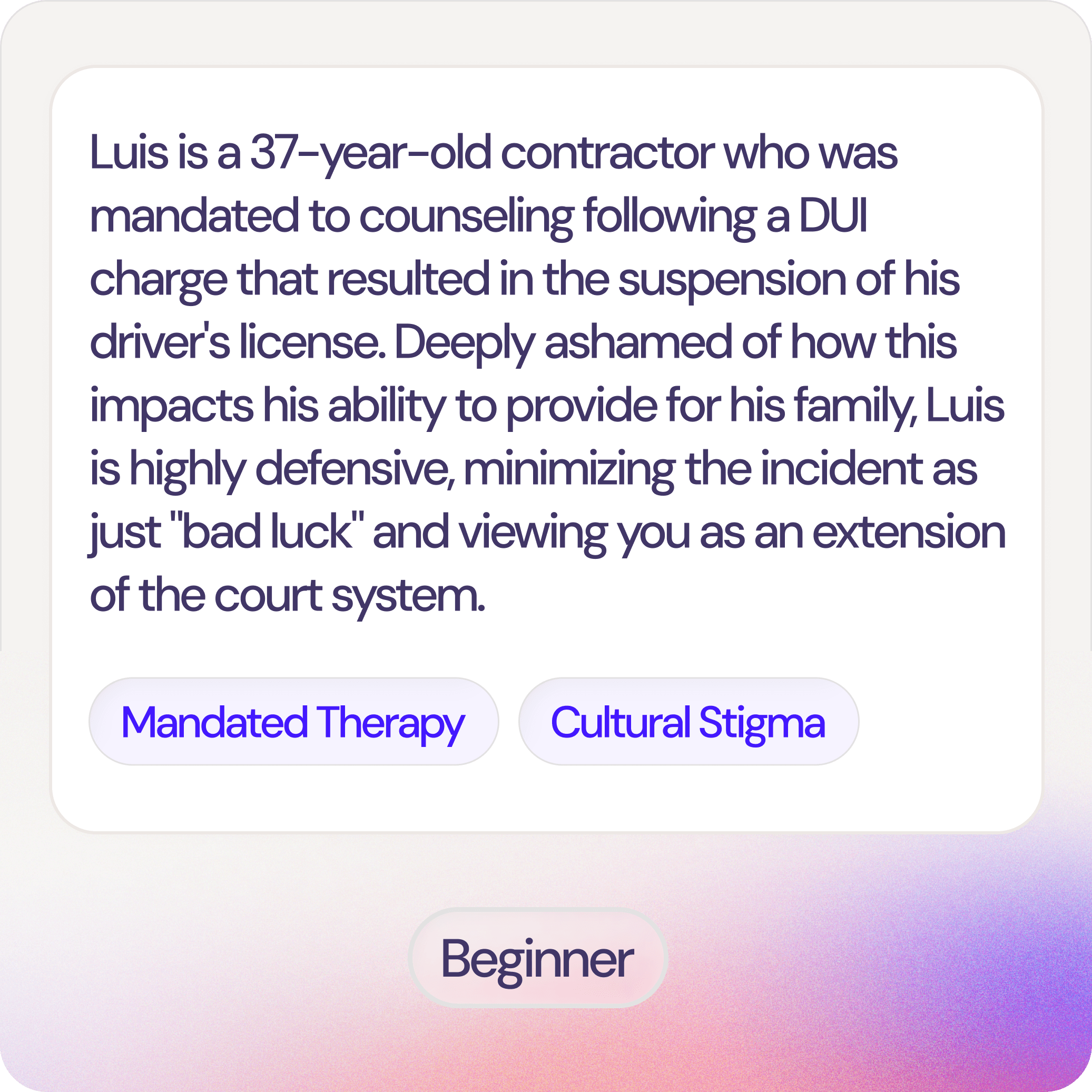
You are picking up mid-session with Luis, a 37-year-old contractor who was mandated to counseling following a DUI charge that resulted in the suspension of his driver's license. Deeply ashamed of how this impacts his ability to provide for his family, Luis is highly defensive, minimizing the incident as just "bad luck" and viewing you as an extension of the court system. Your primary objective in this 5-minute interaction is to balance explaining the limits of mandated confidentiality with building a nonjudgmental alliance. You will need to use Motivational Interviewing techniques, specifically Scaling Questions, to bypass his resistance and collaboratively identify one meaningful, achievable goal for your time together.
Opening Message
"Well... I'm only sitting here because the judge said I had to be. Listen... uhhh... there's a lot of court requirements and lost time for a broken taillight and a couple of beers at my cousin's wedding. I'm not some addict or a criminal, right? I run my own crew. I've got a family to feed, and I can't even drive my own truck to the job site right now. So... I guess I just need to know exactly how many of these sessions I have to sit through before you sign off on my certificate for the DMV. And... uhhh... whatever we talk about in this room, does that just go straight back to the court? Because frankly, I just want to figure out exactly what I need to do to get my license back and put this bad luck behind me."
Module 5: Exploring Fatherhood with Mike
Client Profile
Assignment Description
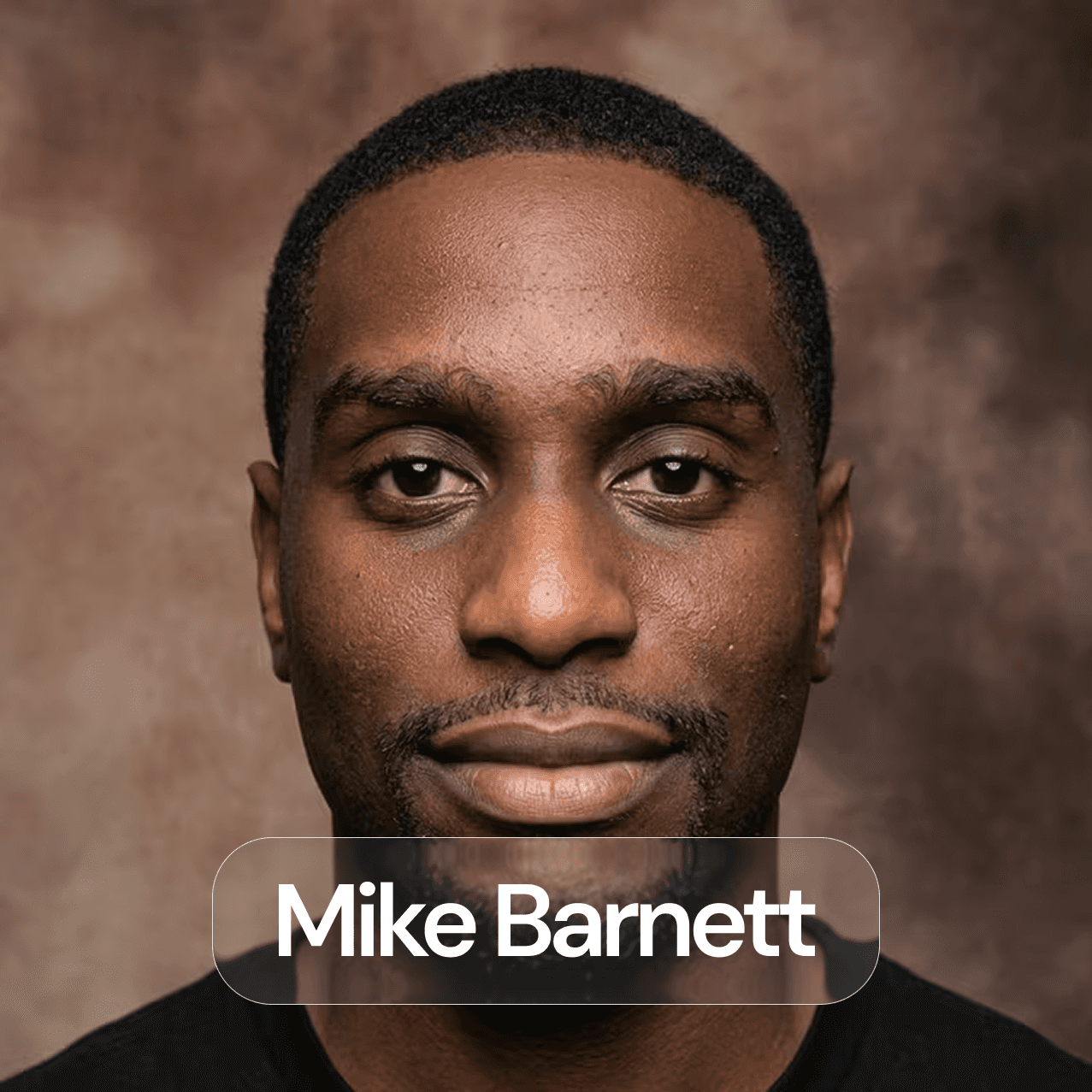
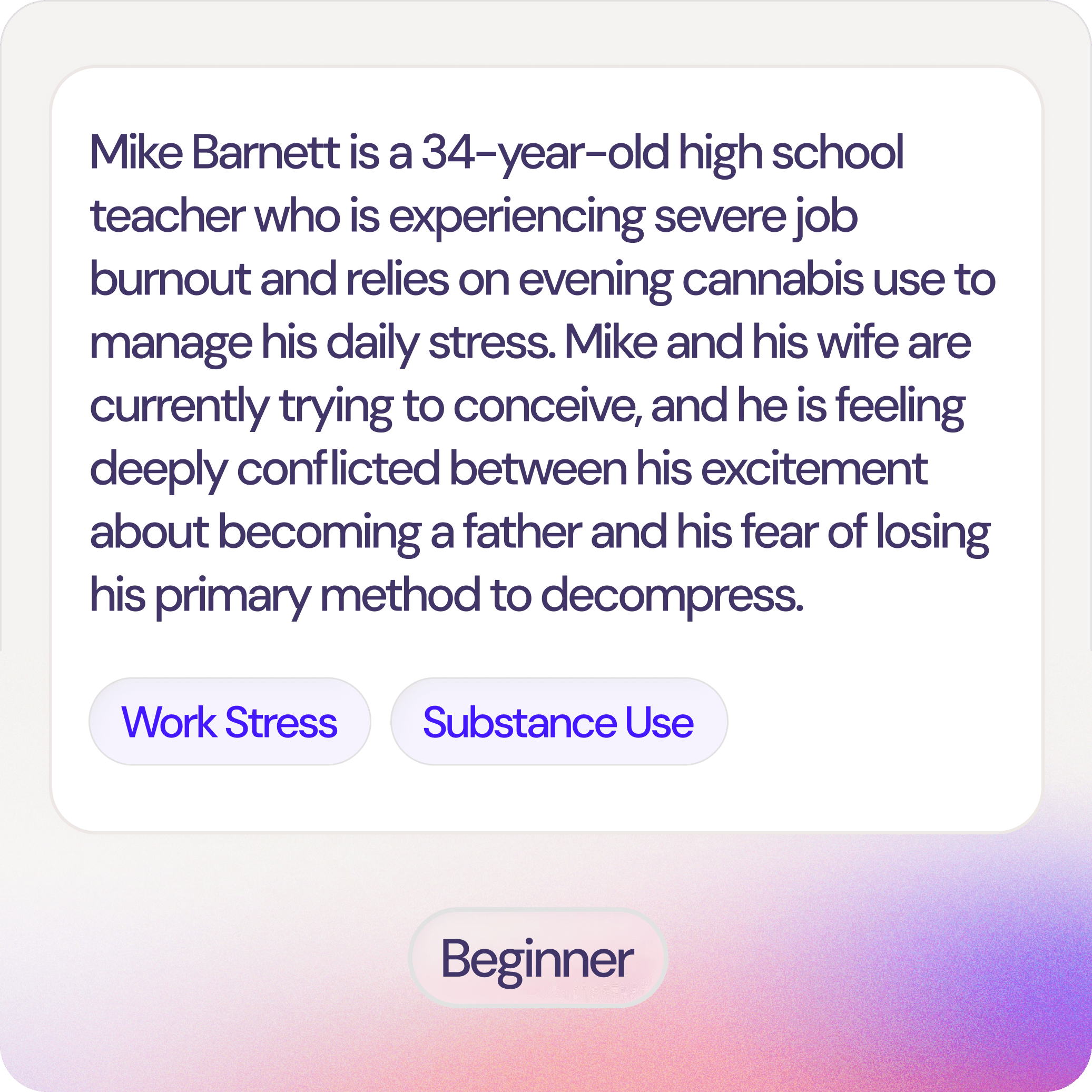
You are picking up mid-way through your fourth session with Mike Barnett, a 34-year-old high school teacher who is experiencing severe job burnout and relies on evening cannabis use to manage his daily stress. Mike and his wife are currently trying to conceive, and he is feeling deeply conflicted between his excitement about becoming a father and his fear of losing his primary method to decompress. Your objective in this 5-minute interaction is to practice the Motivational Interviewing skill of rolling with resistance. You must actively avoid the "righting reflex" (the urge to fix or stop his cannabis use), and instead use double-sided reflections and minimal encouragers to help Mike safely explore his ambivalence without feeling judged.
Opening Message
"Look... I mean... I hear what my wife is saying about stopping the smoking before the baby comes. And... ummm... I want to be a dad, right? I really do. But... uhhhh... at the end of the day, I'm the one standing in the school hallway breaking up fights, and I'm the one listening to my students talk about getting evicted. I pay our mortgage, my classes are passing, and I don't miss a single day of work. So... ummm... smoking on my back porch at night is just... it's how I stop thinking about the school. You see, if I drop the weed... I mean... what exactly is going to stop me from just yelling at my students or bringing all that anger into the house with my new baby? I just... I don't think it's fair that I have to drop the one thing that helps me do my job, man."
Module 6: Checking in with Marna
Client Profile

Assignment Description
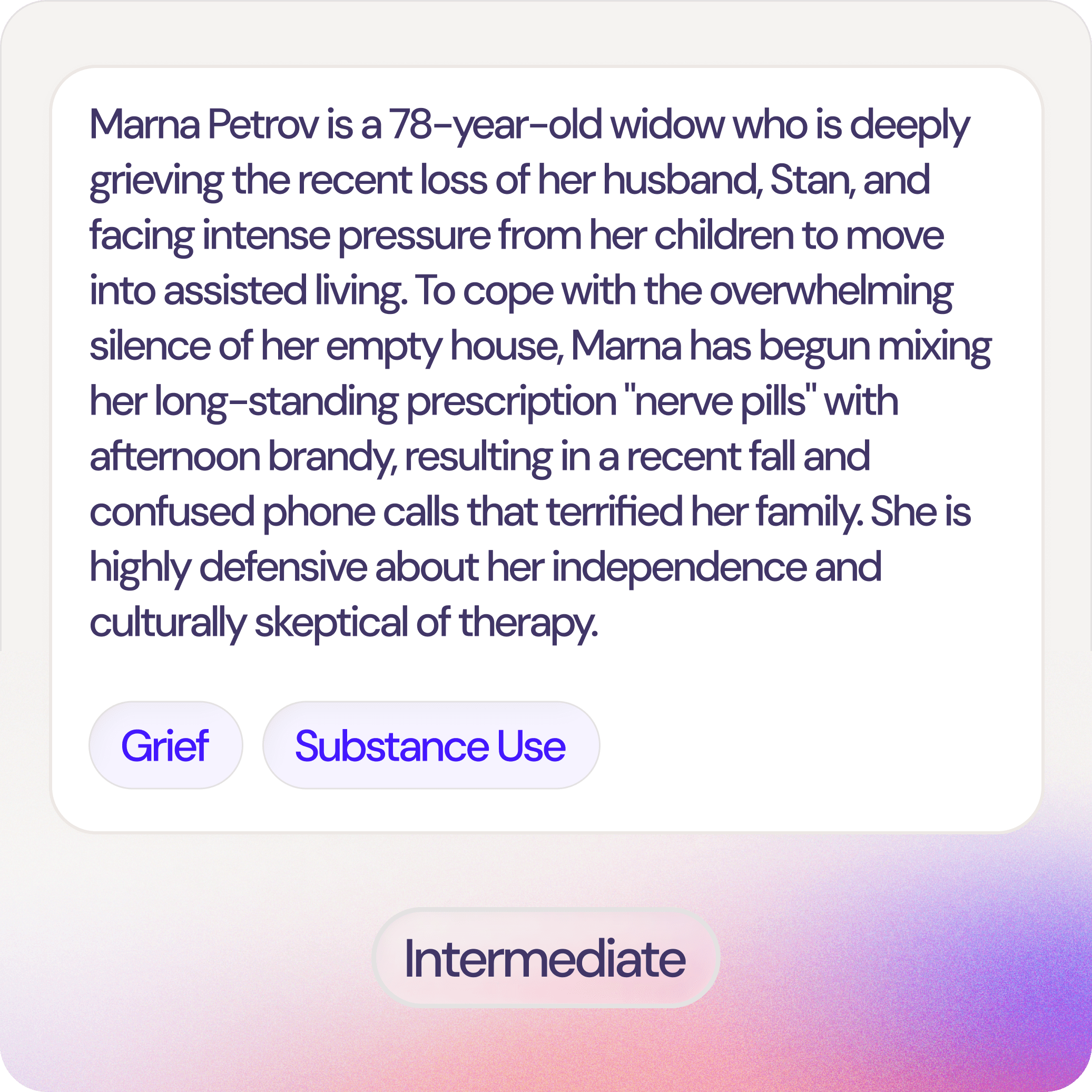
You are picking up mid-session with Marna Petrov, a 78-year-old widow who is deeply grieving the recent loss of her husband, Stan, and facing intense pressure from her children to move into assisted living. To cope with the overwhelming silence of her empty house, Marna has begun mixing her long-standing prescription "nerve pills" with afternoon brandy, resulting in a recent fall and confused phone calls that terrified her family. She is highly defensive about her independence, culturally skeptical of therapy, and views your questions as an attempt to find a reason to force her out of her home. Your objective in this interaction is to use the Ellicity-Respond-Ellicity skill from Motivational Interviewing to explore her perspectives on the fall and provide information about medication interactions while preserving her sense of autonomy.
Opening Message
"Well... please, you must understand, my children are making such a fuss over absolutely nothing. I simply had a little fall in the kitchen, goodness. I am perfectly fine in my own home. But... ummm... they call from three states away and tell me I sound confused on the telephone, and now they want to pack me up and put me in one of those assisted living facilities. Oh, my dear, they just want to put me away so they don't have to worry about me. I try to tell them, I just take the exact same nerve pills Dr. Miller gave me twenty years ago, and... well... I suppose I have a small glass of apricot brandy in the afternoon now. Just to warm my stomach. It is so very quiet in that house without my Stan. Ummm... the television doesn't help at all. The brandy and the pills... they just help me sleep so I don't have to sit in his chair and listen to the clock tick all day. Why is everyone treating me like a foolish old woman just because I want a little peace and quiet?"
Module 7: Building Confidence with Rami
Client Profile

Assignment Description
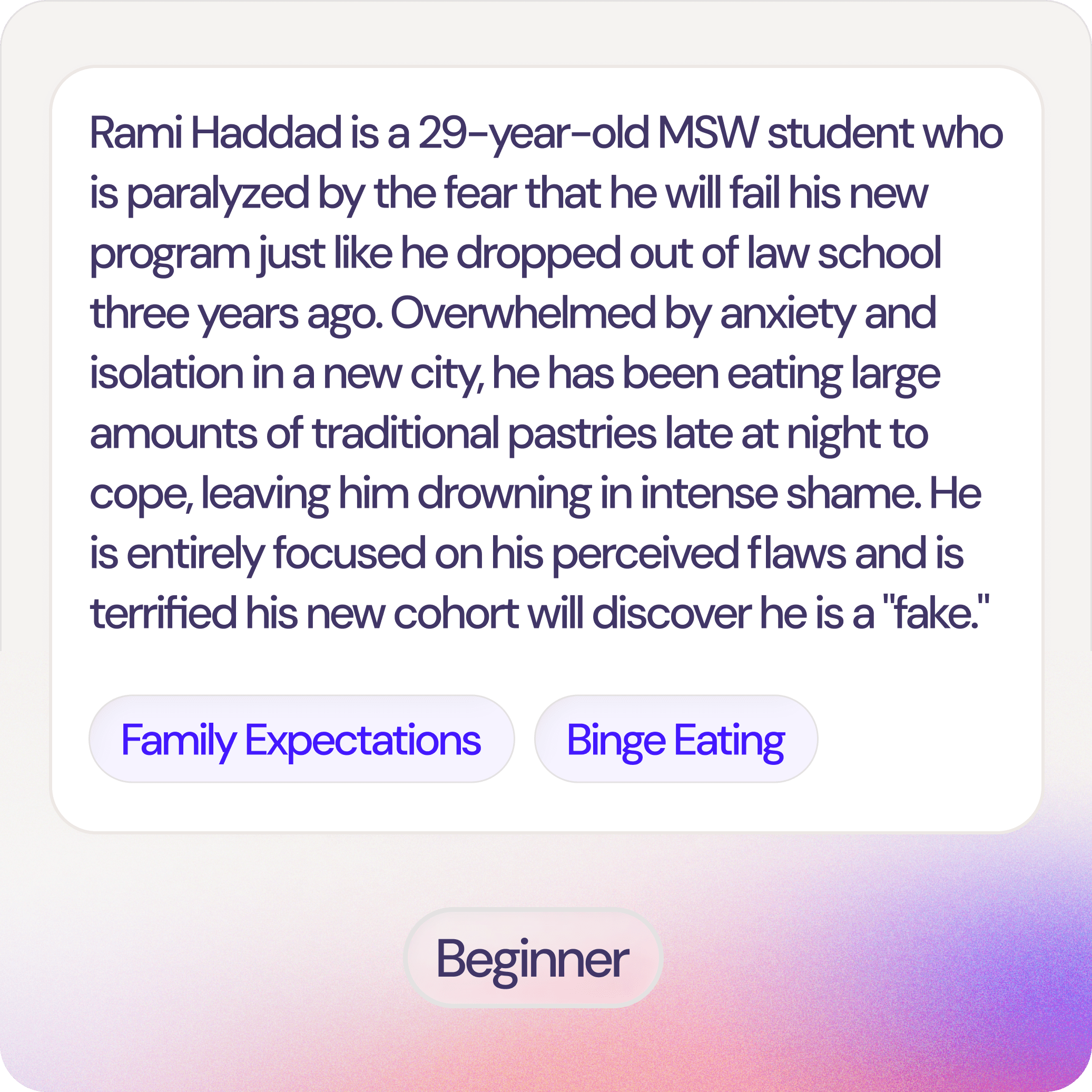
You are picking up mid-session with Rami Haddad, a 29-year-old MSW student who is paralyzed by the fear that he will fail his new program just like he dropped out of law school three years ago. Overwhelmed by anxiety and isolation in a new city, he has been eating large amounts of traditional pastries late at night to cope, leaving him drowning in intense shame. He is entirely focused on his perceived flaws and is terrified his new cohort will discover he is a "fake." Your objective in this 5-minute interaction is to practice using the Motivational Interviewing "Confidence Ruler" to shift his focus from his failures to his strengths. Rather than trying to fix his eating habits today, you will ask him to rate his confidence in making a small change and explore why his number isn't lower, affirming the profound resilience it took for him to return to school.
Opening Message
"I mean... sorry, I know I just keep talking in circles. Basically... I just don't think I can do this. Like, I walk up to the practicum building and my stomach just drops, and I'm convinced everyone in there is smarter than me. They're all going to realize I'm a fake who couldn't even handle my classes three years ago. So... ummm... I just go back to my apartment and order, like, three boxes of baklava and eat until it physically hurts. I guess it just reminds me of my mom's kitchen back home, but then I just feel so disgusting after. Sorry, I'm just a mess right now. I mean... I really want to go to class and actually finish this degree, but I guess I just have zero belief that I can actually change how I'm acting. If that makes sense? I just feel like I'm destined to ruin this and disappoint my parents all over again."
Student Learning Outcomes (SLOs)
By the end of this course and its accompanying simulations, students will be able to:
Demonstrate the foundational Motivational Interviewing skills (OARS) to build rapport with highly resistant or mandated clients.
Differentiate between physiological dependence, substance use disorders, and process addictions across the lifespan.
Successfully suppress the "righting reflex" to help clients safely explore ambivalence regarding their substance use.
Assess safety and apply harm-reduction frameworks for clients engaging in high-risk substance combinations or experiencing suicidal ideation.