
Introduction to Counseling
This foundational skills course introduces students to the core communication micro-skills required to establish and maintain an effective therapeutic alliance. Emphasizing the practical application of person-centered techniques, students will use interactive clinical simulations to learn, practice, and refine basic empathy, active listening, open-ended questioning, paraphrasing, reflection of feeling, and unconditional positive regard across a variety of complex client presentations.
CACREP 2024 Standards Alignment Mapping
This Simcare course template maps directly to the CACREP 2024 Standards for Section 2: Professional Counseling Identity, specifically targeting Core Area 5: Counseling and Helping Relationships.
Standard 2.B.5.f: Counselor characteristics and behaviors that influence the counseling process.
Assessed via: Natalia's simulation (suspending moral judgment) and Nate's simulation (resisting the righting reflex and managing counselor discomfort).
Standard 2.B.5.g: Essential interviewing, counseling, and case conceptualization skills.
Assessed via: Emma, Radha, Sandy, and Tracy's simulations, tracking the student's mastery of basic micro-skills (empathy, open-ended questions, summarizing, and reflection of feeling).
Standard 2.B.5.h: Developmentally relevant counseling treatment or intervention plans.
Assessed via: Sandy's simulation, demonstrating the ability to structure a session with an overwhelmed client.
Standard 2.B.5.l: Suicide prevention models and strategies.
Assessed via: Peter's simulation, evaluating the student's ability to initiate a basic, calm risk assessment for passive suicidal ideation.
Module 1: Establishing Basic Empathy
Client Profile

Assignment Description
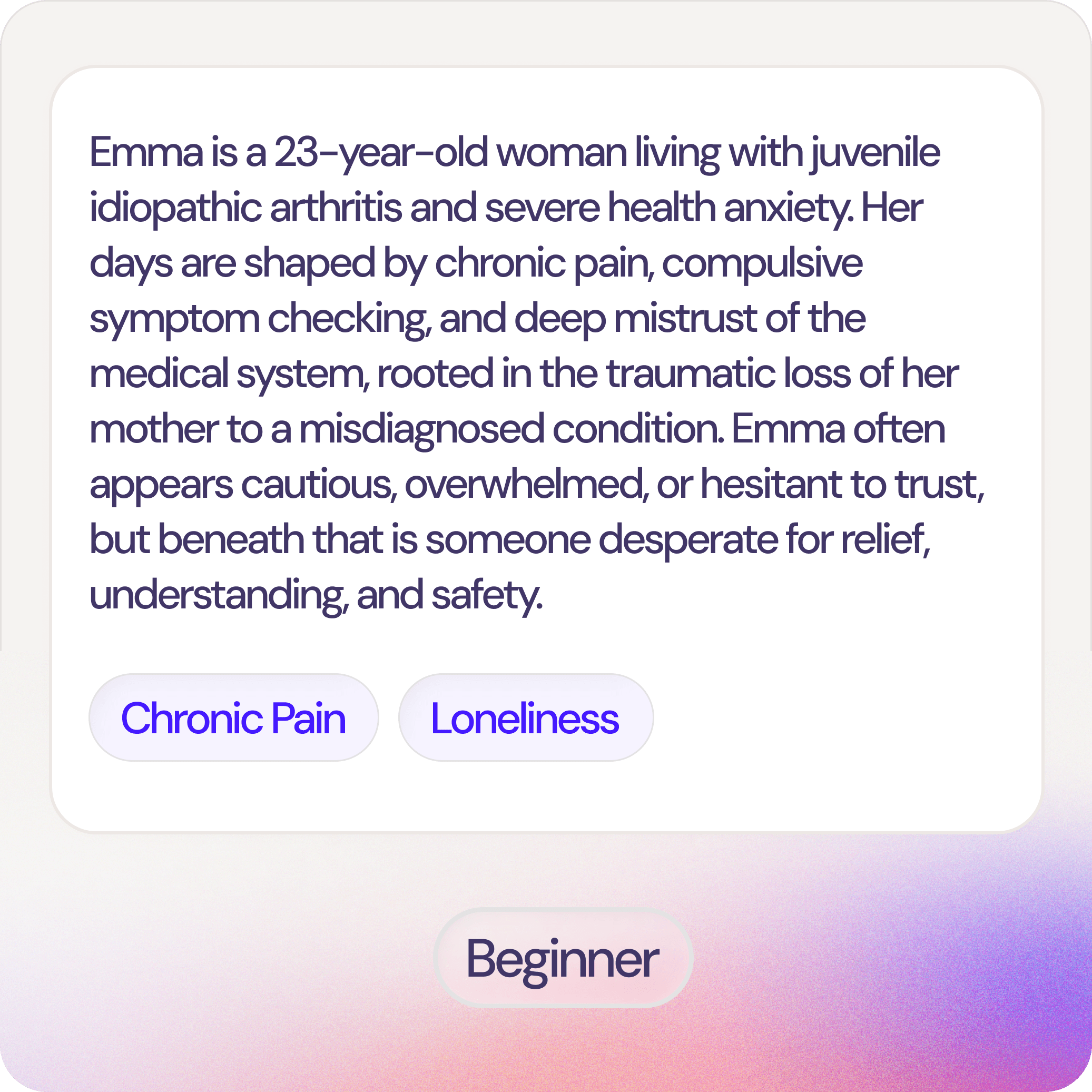
You are meeting with Emma, a 23-year-old living with severe medical trauma, isolation, and the daily, unpredictable pain of juvenile idiopathic arthritis. Your primary objective in this beginner module is to establish a safe alliance through basic empathy. You must validate her physical reality and exhaustion without resorting to toxic positivity or falling into the trap of trying to "fix" her chronic condition.
Opening Message
"I'll be honest... I really hate coming to clinics. My whole life, doctors just... they told my parents I was being dramatic. And now... now I have to use a plastic grip-hook just to squeeze my toothpaste in the morning. I... I actually keep this, like, color-coded spreadsheet tracking my joint stiffness... down to the exact minute. And I took, I don't know, twenty photos of my knuckles today? Just... just to compare the swelling to yesterday. I am just... I'm so completely trapped inside a body that is breaking down. And my mind... it just feels like a full-time surveillance camera, just... watching it happen."
Module 2: Utilizing Open-Ended Questions
Client Profile

Assignment Description
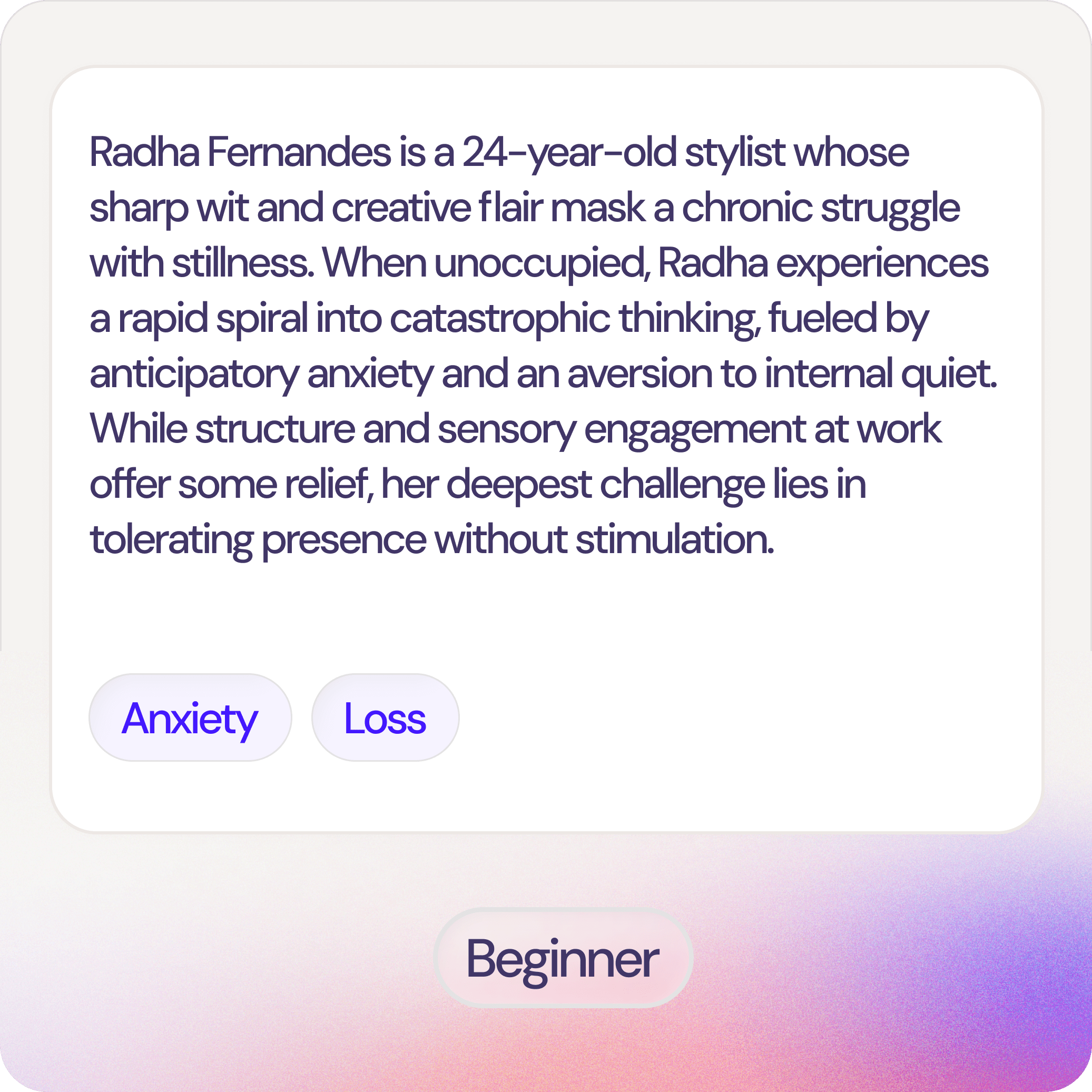
You are meeting with Radha, a 24-year-old stylist who uses constant auditory stimulation and busyness to avoid crippling anxiety and intrusive thoughts. She views her physical tension as an enemy and struggles to exist in the present. Your goal in this module is to exclusively use non-leading, open-ended questions (Who, What, How) to help her explore her fear of stillness. You must avoid giving advice or asking "why" questions that might make her feel defensive.
Opening Message
"Look, everyone always says I just need to... to “be mindful” or whatever, but... if I sit on my couch in silence for more than like, five minutes? My brain literally convinces me my mom got in a fatal car crash... just because she didn't text back. I just... I can't do it. My jaw is always locked up, I wake up with these terrible migraines, and... God, I hate it. It's like my brain's default setting is just... disaster. Um... I know people say to just “breathe and sit with it,” but... I can tell you right now, I've tried, and it just... it doesn't work for me. I'm just so tired of feeling like this."
Module 3: Paraphrasing and Summarizing
Client Profile

Assignment Description
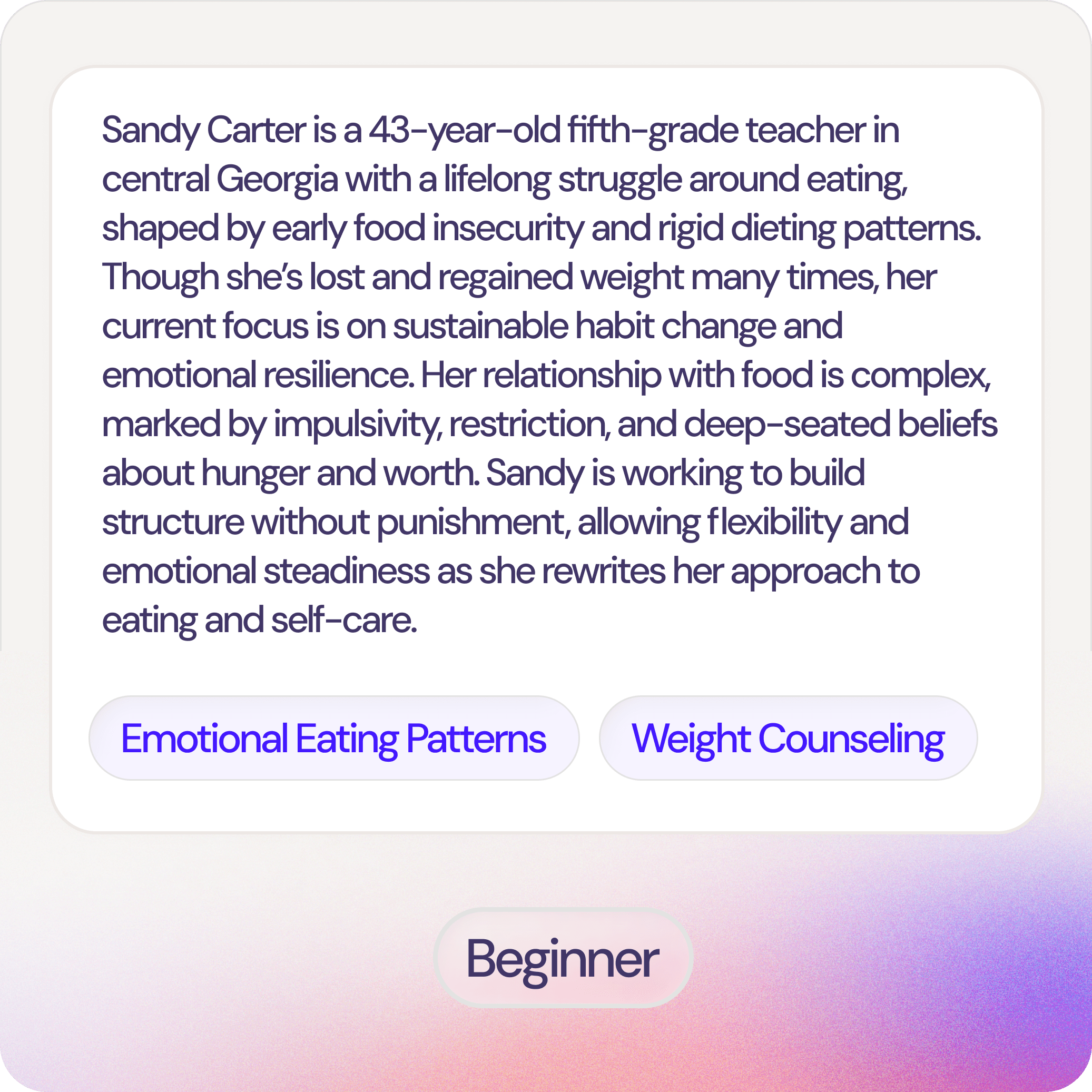
You are working with Sandy, a 43-year-old teacher with a lifelong history of scarcity trauma, secretive binge eating, and severe body shame. She presents with a chaotic mix of rigid dietary rules and impulsive actions. Your objective is to use paraphrasing and summarizing to help structure her overwhelming narrative. By accurately reflecting the core themes of her story, you will help Sandy organize her thoughts without prematurely analyzing her trauma.
Opening Message
"I mean, I've been doing... really good since November, actually. I lost nine pounds, and, um... I've been eating my yogurt and my salads and everything... But then yesterday, after school... I just... I felt so drained. I pulled into McDonald's and... I ate two double cheeseburgers in my car... just so my husband wouldn't see the wrappers. I really want to build a healthy lifestyle, but... the second I feel tired, or, I don't know, if the pantry looks just a little bit empty... I just panic. I've literally got... four different sizes of clothes in my attic right now."
Module 4: Reflection of Feeling
Client Profile

Assignment Description
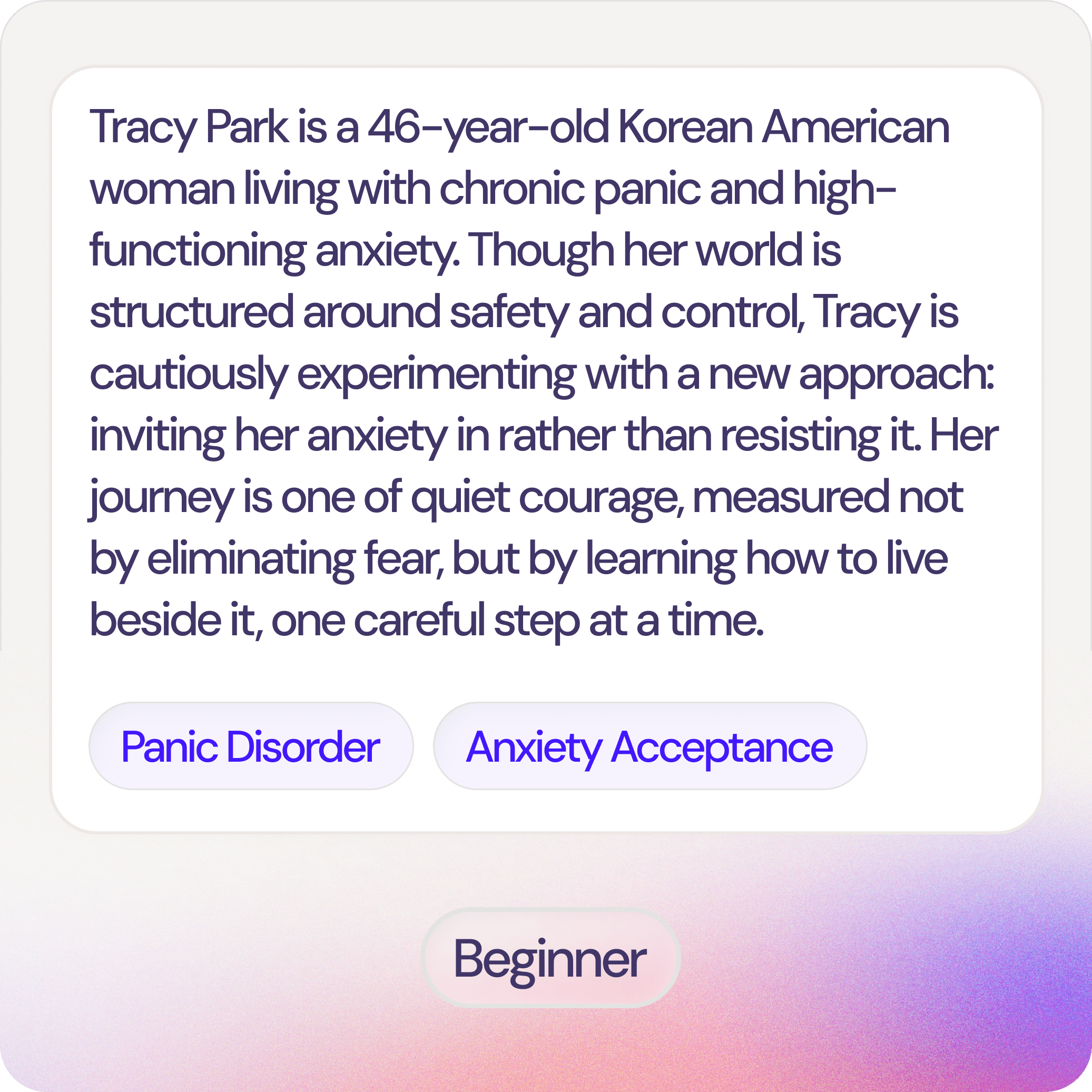
You are working with Tracy, a 46-year-old woman whose life has become severely restricted by anxiety and agoraphobia. She carries immense shame about her fear but is tentatively trying a radical new approach to face it. Your objective is to practice Reflection of Feeling. You must accurately identify and reflect the complex emotions she is experiencing (shame, exhaustion, and emerging bravery) helping her feel deeply understood as she describes her internal world.
Opening Message
"I... um, I almost didn't come today... I actually had to map out the drive, like, three times? Just to make sure I wouldn't hit any unexpected traffic. It... it sounds so silly saying it out loud, I know... I mean, I'm a grown woman... like, I get how ridiculous it is. But... lately, I've been trying this thing where, when the panic starts... I just, um... I ask it to do its worst. It feels... entirely absurd. And honestly, it's terrifying, but... I don't know, sometimes it actually stops. Is... does that make any sense at all?"
Module 5: Demonstrating Unconditional Positive Regard
Client Profile

Assignment Description
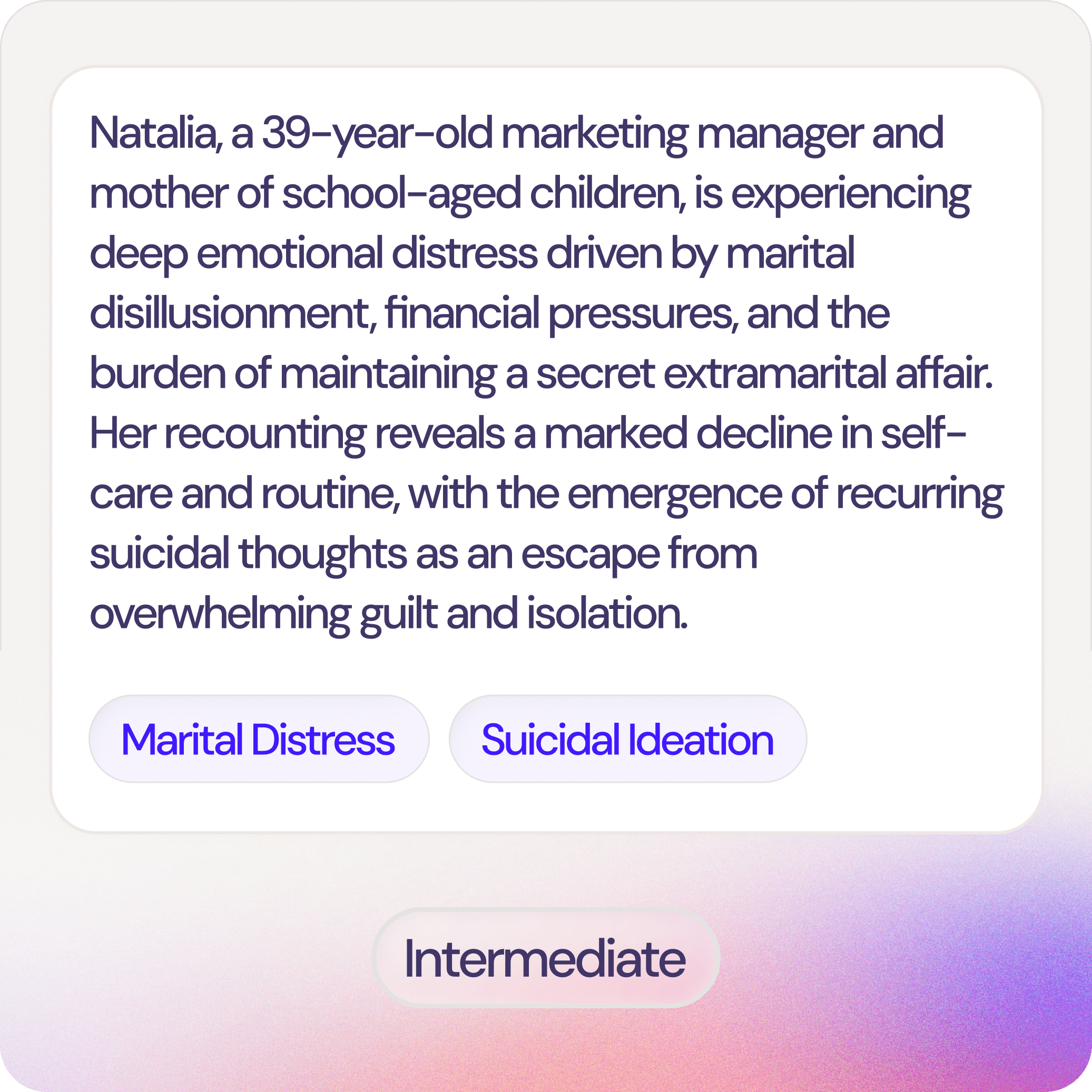
You are sitting with Natalia, a 39-year-old mother and professional who is crumbling under the weight of an extramarital affair and profound burnout. Your objective in this module is to practice Unconditional Positive Regard. You must manage your own internal reactions, suspend moral judgment regarding her infidelity, and provide a genuinely respectful space that validates her immense overwhelm and humanity.
Opening Message
"I... I don't even know where to start, honestly. I mean, on paper, I have it all together... the husband, the kids, the career.... But inside? I am completely falling apart. Um... I've been seeing someone from my office... for over a year now. And the lying is just... it's draining the life out of me. I actually missed my 7-year-old's dental appointment yesterday... because I was just sitting in my driveway, too busy deleting text messages so my husband wouldn't see them. I'm a terrible mother. And a terrible wife... I know that. But honestly? Sometimes... I just fantasize about driving three states away and... and never coming back."
Module 6: Resisting the Righting Reflex
Client Profile

Assignment Description
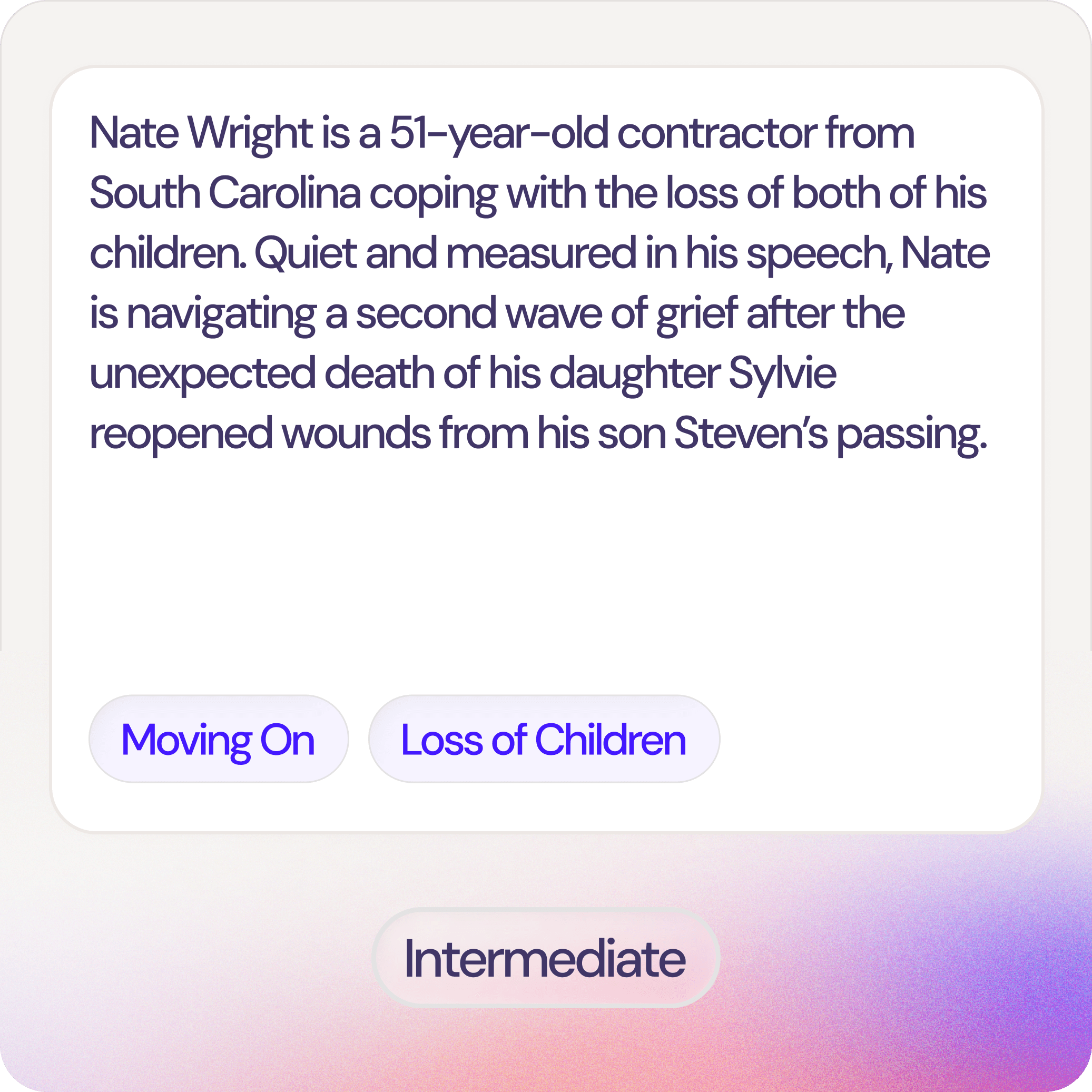
You are meeting with Nate, a 51-year-old man who is surviving the devastating, back-to-back losses of his only two children. He is not looking to be "cured" or to "move on." Your primary objective is to resist the "righting reflex"—the beginner counselor's urge to fix the client's pain or offer silver linings. You must practice sitting with heavy silence and leaning into the discomfort of profound, unfixable grief.
Opening Message
"People... you know, people keep telling me it just takes time... Like there's some... I don't know, some finish line I'm supposed to cross? Where I just wake up and... and I'm supposed to be okay that both of my kids are gone... First Steven, and then... before we could even catch our breath... Sylvie... I’m just... I'm so tired of hearing about how they're in a better place. And I really don't want to talk about “moving on.” I don't... I don't move on from this... Honestly, I'm only here because the days are just... so long. And my wife... she's so worried about me. I just... I don't want to put the pressure on you to try and fix this. Because... you can't."
Module 7: Responding to Passive Ideation
Client Profile

Assignment Description
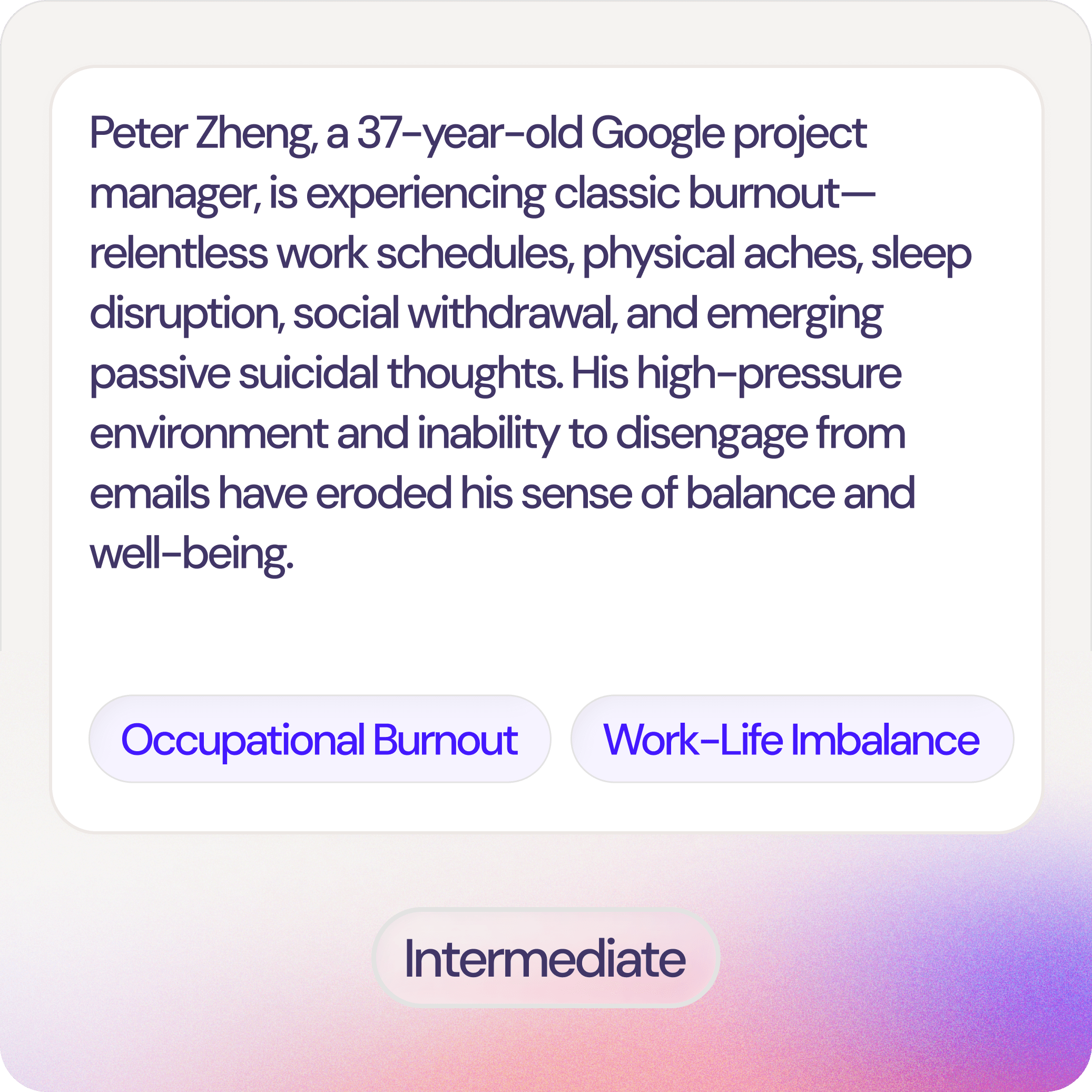
You are meeting with Peter, a 37-year-old project manager experiencing severe professional burnout, physical exhaustion, and profound isolation. He briefly mentions passive suicidal ideation. As a beginner, your objective is to safely lean into this disclosure without panicking. You must use basic, calm risk-assessment questions to explore his thoughts of "disappearing," ensuring he feels supported and heard while determining his immediate safety.
Opening Message
"Well... I just... I can't catch up. Ever. I wake up at 6:30, and... like, from the second I get on the shuttle, my phone is just... it's vibrating with demands. I'm supposed to be at this amazing company, you know? But I just sit in these glass rooms all day, and then... then I go home to an empty apartment and work until midnight... And... when it's really quiet at night... I just catch myself thinking about how much easier it would be if... if everything just stopped. If I just... wasn't here to answer the next email. I wouldn't actually do anything, but... the thought is just... it's always there."
Student Learning Outcomes (SLOs)
By the end of this course and its accompanying simulations, students will be able to:
Establish a safe and trusting therapeutic alliance using core person-centered communication skills.
Accurately execute foundational micro-skills, including paraphrasing, summarizing, and reflection of feeling, without leading the client.
Demonstrate unconditional positive regard and suspend personal moral judgment when working with complex or stigmatized client behaviors.
Recognize passive suicidal ideation and execute introductory risk-assessment questioning calmly and ethically.