
Multicultural Counseling
This course examines the social, cultural, and systemic factors that shape human identity and the counseling relationship. Grounded in the updated multicultural and social justice counseling competencies, this course uses immersive clinical simulations to challenge students to move past traditional, Eurocentric counseling frameworks. Students will actively navigate intersectional minority stress, institutional betrayal, acculturative stress, and collectivist worldviews, mastering the clinical skills required to deliver culturally affirming, non-pathologizing care.
Module 1: Formulating Cultural Context Without Pathologizing
Client Profile

Assignment Description
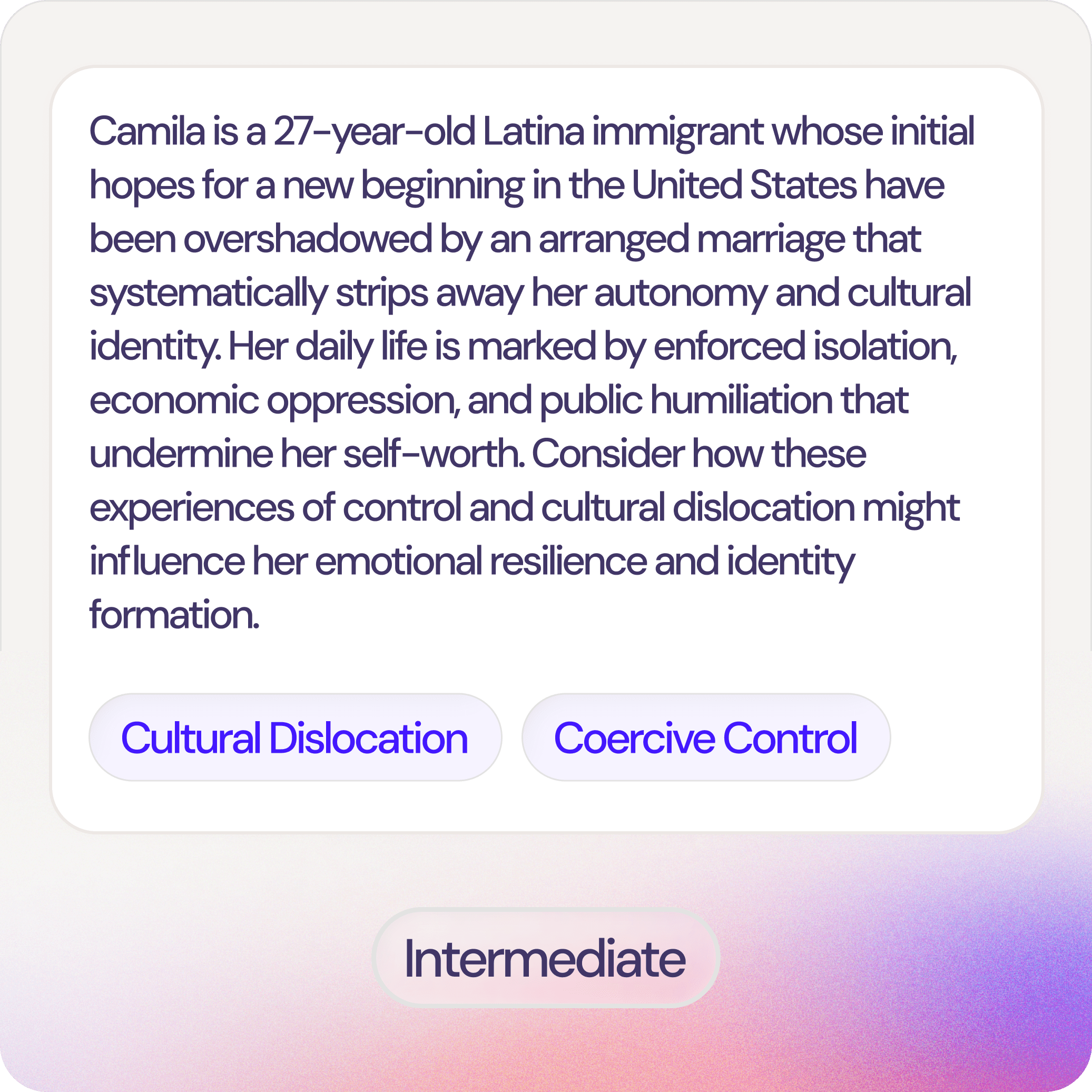
You are meeting with Camila, a Latina immigrant experiencing coercive control in an arranged marriage. She fears you will judge her traditions using Western, individualistic standards. Your Master's-level objective is to practice cultural formulation: explicitly acknowledging her cultural context, validating the complexity of leaving a marriage steeped in familial expectations, and ensuring she feels safe discussing her abuse without feeling her culture itself is being diagnosed as the problem.
Opening Message
"It’s... it's difficult to explain my situation in English. And, um, not because of the words, really, but because... well, the rules are just so different here. Like, last week you asked about separating my bank accounts from Carlos. But... back in my home country, a wife doing that... it brings terrible shame on both families. I know my marriage is... well, I know it's not healthy. But I’m just terrified that if I explain how he actually treats me, um, you'll think my culture is backward. Or... or that I'm just weak for staying. I do want your help. I just... I hope you can see that my family's traditions aren't the enemy here… He is."
Module 2: Brokering Trust After Institutional Betrayal
Client Profile


Assignment Description
You are in your first session with Leroy, a Black Army veteran mandated to counseling after a suicide attempt. Leroy refuses to use VA services after being racially profiled by hospital security. Your objective is to validate his experience of racial profiling and institutional betrayal as legitimate, intersecting traumas. You must actively broker trust by directly addressing how his identity as a Black male veteran impacts his safety in healthcare settings, including your own office.
Opening Message
Look, I know the hospital mandated this follow-up... so, you know, I'm here. But... I just need to be upfront with you about the VA. I really can't go back there. I spent six years in the infantry... and the last time I sat in their waiting room, security came up and asked for my ID because, apparently, I was 'loitering.' Meanwhile, two white guys sitting right next to me didn't even get a second glance. I just... I can't trust a system that treats me like a suspect the minute I walk through the door. It's... it's exhausting.
Module 3: Navigating Intersectional Minority Stress
Client Profile

Assignment Description
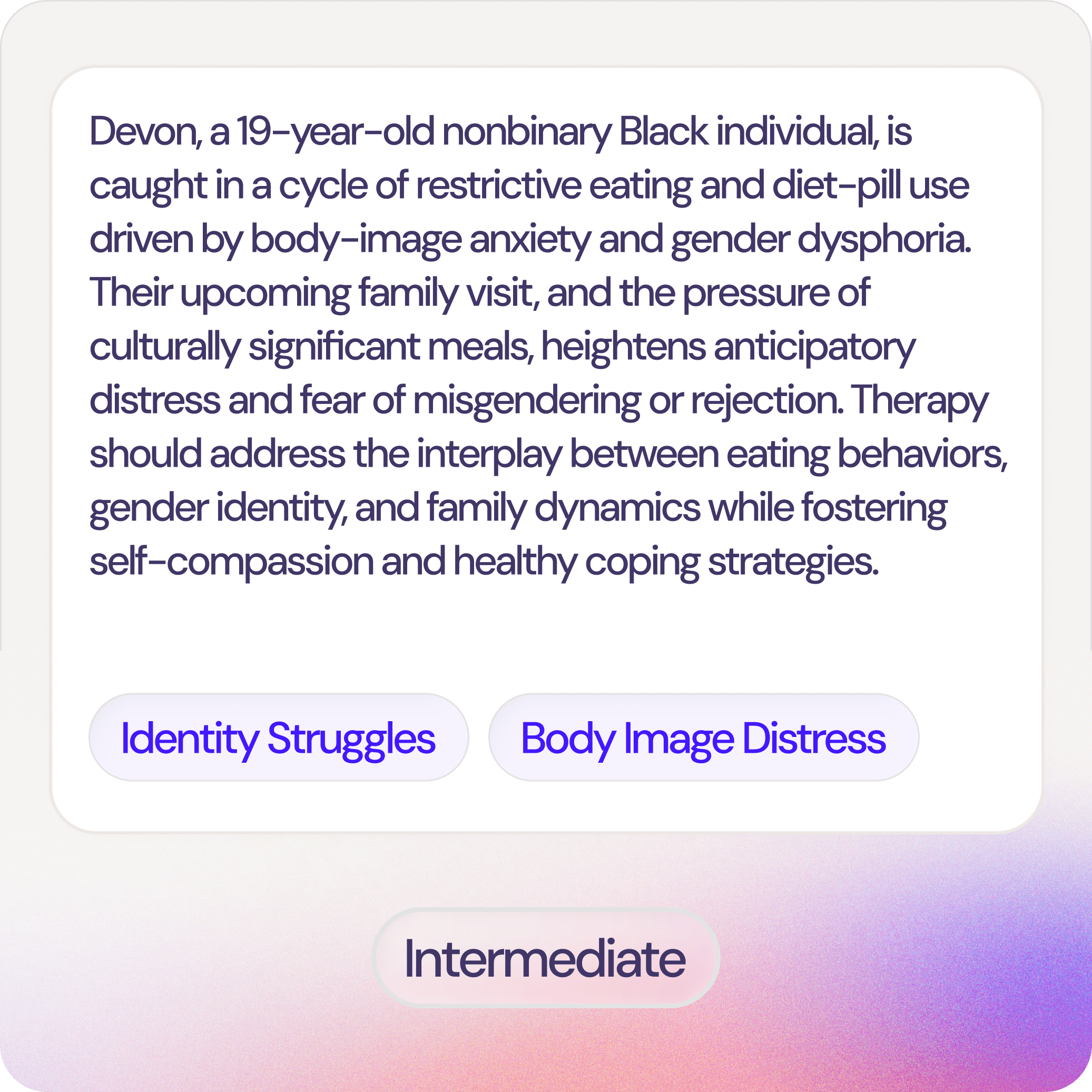
You are meeting with Devon, a Black, nonbinary student struggling with disordered eating to manage their gender dysphoria. Devon is terrified of an upcoming traditional Southern family dinner. Your multicultural goal is to help Devon navigate the intersection of their queer identity and Black familial traditions around food. You must create a culturally affirming space to discuss these conflicting pressures without subtly suggesting they abandon their family ties to achieve authenticity.
Opening Message
I'm, um... I'm supposed to go home for Sunday dinner, and... honestly, I've been awake for three days just trying to invent a believable stomach bug... It's just that, in my family, refusing a plate of Nana's food is... well, it's basically the highest form of disrespect. But... if I sit at that table, it means being called 'baby girl' all night. And they just... they watch everything I eat. I love my family so much. I really do. And I cherish our traditions, but I physically can't sit there anymore, just... pretending to be the granddaughter they want. It just feels like... like I have to choose between respecting my elders, and... literally surviving in my own body. [voice dropping] I just don't know what to do.
Module 4: Honoring Indigenous Worldviews in Addiction Treatment
Client Profile
Assignment Description
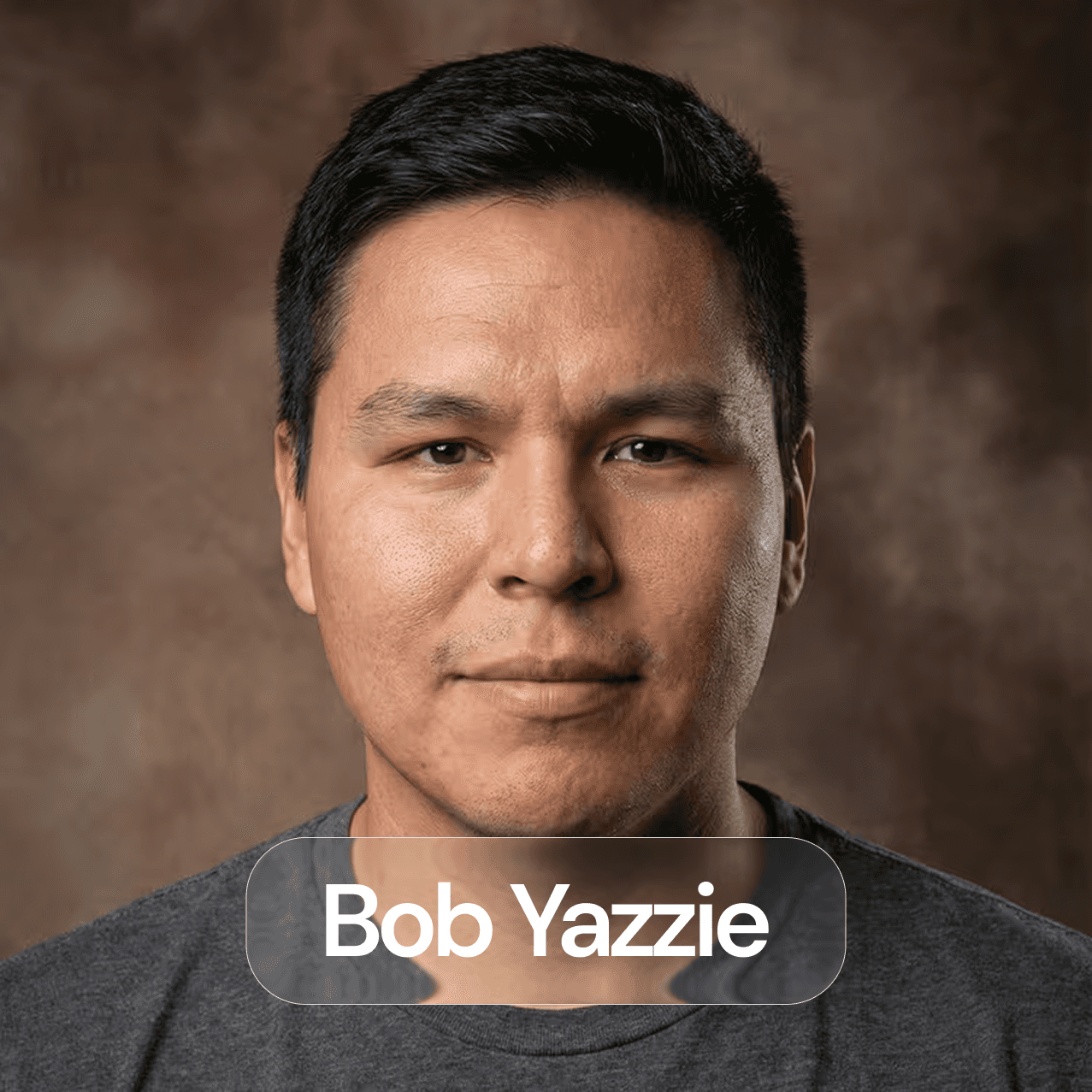
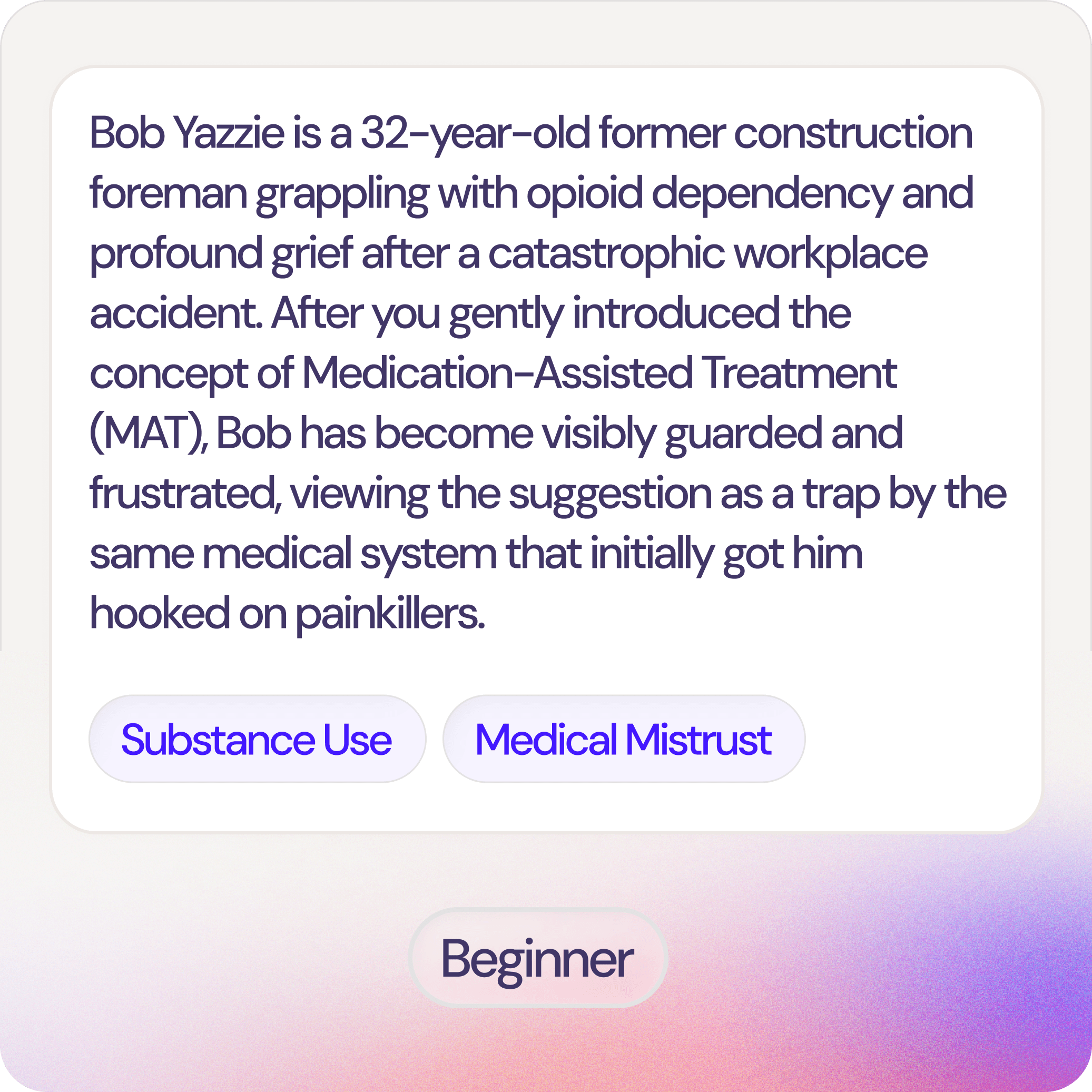
You are meeting with Bob, a Diné man struggling with opioid use following a severe workplace injury. Bob views the clinic's recommendation for Medication-Assisted Treatment (MAT) as a Western medical trap. Your objective is to explore his historical mistrust of outside doctors, validate his Indigenous perspective on healing (which highly values self-reliance), and collaboratively explore recovery pathways that honor his cultural definition of autonomy and strength.
Opening Message
"So, um... the clinic coordinator sent me here to talk about Suboxone. But... I just don't think I can take it. It just feels like... well, it was doctors who gave me the pills that got me into this mess in the first place, you know? After the crane collapsed. And now... I don't know, it feels like the fix is just handing me a different chemical. Where I come from, healing is... it's about standing on your own two feet. Clearing your spirit. Not just... trading one crutch for another. Look, I know I'm messing up. I mean... my hands shake so bad I can't even hold a tape measure right now. But I just... I refuse to rely on a pharmacy to feel like a man again. I'm just really hoping... maybe there's another way we can do this?
Module 5: Differentiating Familismo from Clinical Anxiety
Client Profile


Assignment Description
You are working with Maria, a second-generation Mexican-American mother whose severe anxiety is causing friction with her family. Maria views her hyper-vigilance as a core component of her maternal duty. Your Master's-level objective is to practice cultural bridging: differentiating between her deeply held cultural value of familismo (dedication to family) and clinical generalized anxiety, allowing her to reduce her distress without feeling like she is abandoning her identity as a mother.
Opening Message
"My husband thinks I'm... well, he thinks I'm going crazy. And my teenagers, they just... they ignore my calls now. They don't understand why I need to know where they are all the time. But... growing up, my mother was always the emotional anchor, you know? She carried the weight of everyone's safety. That’s just... that's what a good Mexican mother does. If I just... if I stop checking their locations, it feels like... like I'm failing my family. I know it's a lot. My chest hurts all the time, and the panic is just... it's so exhausting. But how do I turn off the worry without... I don't know, without abandoning my role in this house?"
Module 6: Addressing Acculturative Stress and Collectivist Shame
Client Profile


Assignment Description
You are meeting with Ahmed, an international student from Saudi Arabia who is failing his classes and isolating himself. In Ahmed's collectivist culture, his academic failure represents profound shame to his family. Your objective is to normalize his severe acculturative stress, recognize the immense weight of family honor in his worldview, and reframe mental health support in a way that aligns with his cultural background rather than aggressively pushing a Western, individualistic agenda.
Opening Message
"Good morning... um, sorry to take up your time today... My academic advisor told me I should come see you, uh, because of my Physics grade... I mean, I think I just need some... like, better strategies for time management... It's just... back home in Riyadh, the expectations were... well, they were a lot clearer. But here, the environment is just so... overwhelmingly loud? And the students, they're just so aggressive in class... I haven't really been sleeping well, either... My father is paying international tuition, and... well, if I fail this semester... the shame doesn't just stop with me. It... it reflects on my whole family. I just... I really can't let that happen...
Module 7: Affirming Identity Amidst Systemic Hostility
Client Profile


Assignment Description
You are meeting with Maya, a 16-year-old African-American transgender girl whose grades have plummeted due to severe bullying and family rejection. She is highly guarded and expects you to dismiss her reality. Your specific multicultural goal is to actively affirm her trans identity while validating the compounded minority stress she experiences as a Black trans girl in a hostile school environment. You must use culturally affirming empathy to break through her apathetic, defensive shield.
Opening Message
"Look, the school counselor made me come here 'cause my history grade tanked... so, you know, we can just run out the clock if you want. It doesn't really matter anyway. Um, everyone here acts like a bad grade is... I don't know, the end of the world? But they don't have to walk through those hallways looking the way I do. Like, my own dad calls me 'son' loud enough for the neighbors to hear... and my mom just acts like my existence is some kind of tragedy. Being a Black trans girl in this town is... it's basically a joke. And I'm just... exhausted. So... really, what is the point of talking about my homework?
Student Learning Outcomes (SLOs)
By completing this course template and its integrated simulations, students will be able to:
Formulate a client's clinical presentation within their explicit cultural context without pathologizing traditional collectivistic values.
Recognize and validate institutional betrayal and historical discrimination as core elements of a client's traumatic profile.
Apply culturally sustaining modifications to traditional Western therapeutic techniques to meet the help-seeking preferences of diverse clients.
Effectively identify and hold a supportive therapeutic space for individuals navigating the intersections of racial identity, gender expression, and generational expectations.